
How to Start Off-Leash Training for Dogs Safely
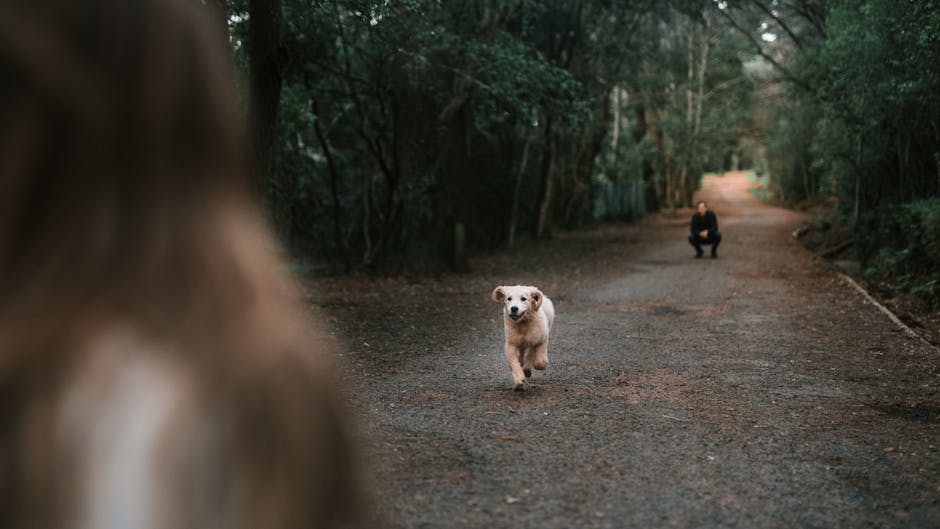
Start with a leash, not an open trail. Teach your dog to check in, come when called, stop on cue, and leave distractions alone. Practice in a fenced space, then use a long line to test those skills outdoors. Let your dog off-leash only where it is legal and safe, and where they can respond despite nearby people, dogs, or wildlife.
At Free Reign K9 LLC, we use a balanced training approach: clear teaching and feedback suited to each dog and situation. For everyday walking, we recommend a standard 6-foot, 1/2-inch braided leash made from quality leather, not a body harness or anti-pull leash. We may use tools such as prong collars and e-collars when their safe, proper use fits the dog and training plan.
I'm Kim Blanton, a dog trainer at Free Reign K9 LLC in Tacoma, where I help owners build obedience and stronger relationships with their dogs. My work with off-leash training for dogs focuses on the skills that make outdoor adventures safer and more enjoyable.
Understanding Off-Leash Walking vs. Off-Leash Freedom
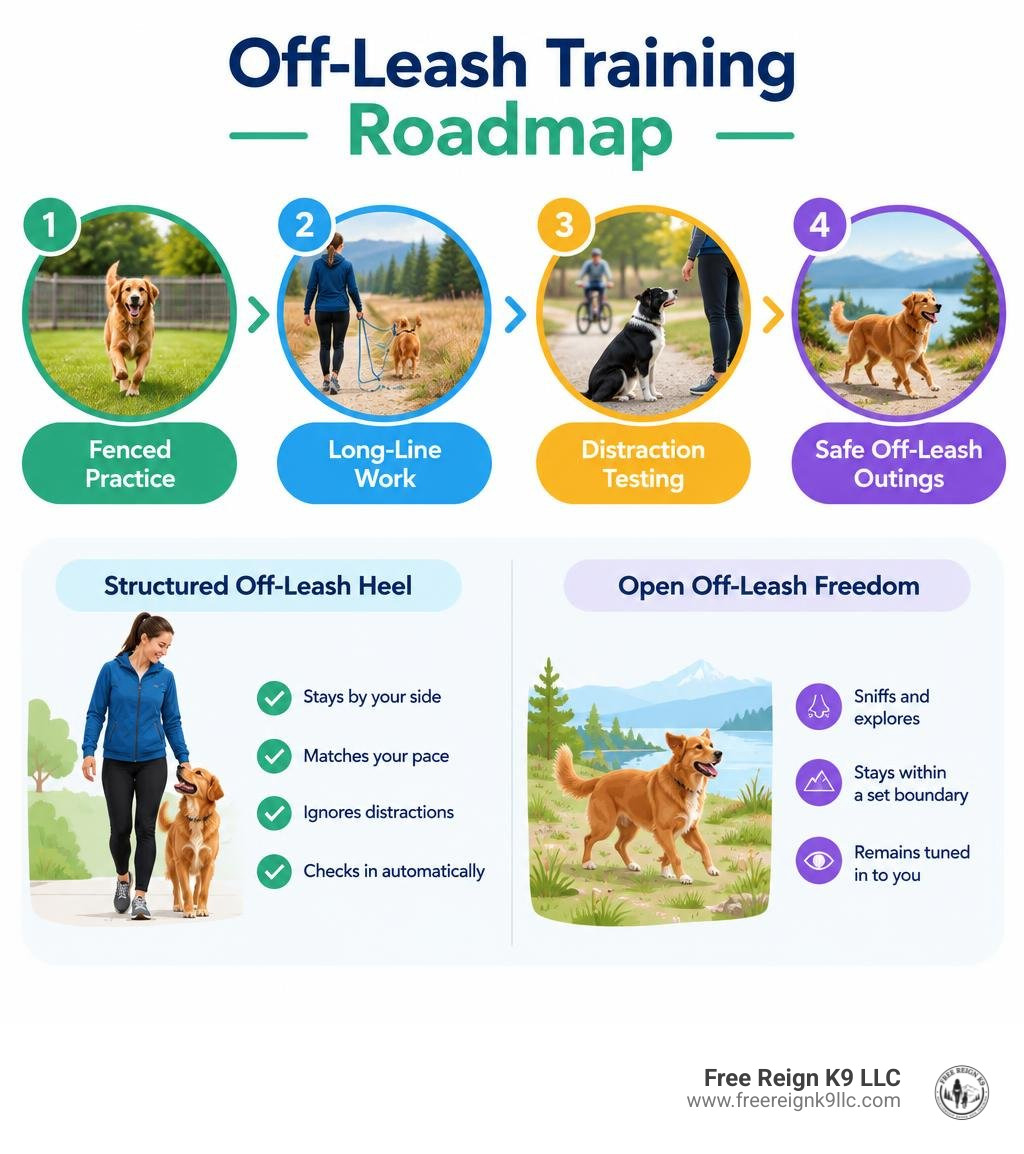
Many pet owners picture off-leash time as an open field where their dog runs wild without boundaries. True reliability requires knowing the difference between a structured off-leash heel and open exploration freedom.
A structured off-leash heel means your dog stays right by your side, matching your pace, ignoring outdoor distractions, and checking in automatically. This is ideal when passing other hikers, navigating neighborhood streets, or walking past unfamiliar dogs. Open off-leash freedom allows your dog to sniff, explore, and run within a set boundary while staying mentally tuned in to you.
| Feature | Structured Off-Leash Heel | Open Exploration Freedom |
|---|---|---|
| Position | Directly at handler's side (knee alignment) | Within an established safety radius (20 to 50 feet) |
| Primary Goal | High precision, polite passing, hazard navigation | Mental decompression, physical exercise, sniffing |
| Handler Focus | Continuous, active engagement | Periodic check-ins and responsiveness to distance cues |
| Best Used In | High-traffic trails, busy sidewalks, passing triggers | Safe open fields, approved off-leash parks, quiet trails |
At Free Reign K9 LLC, our balanced training philosophy advocates education and the safe, proper use of training tools based on the individual dog and situation. We do not leave off-leash control to luck or assume every dog naturally understands boundaries.
About 66% of dogs show some signs of reactivity when faced with sudden environmental triggers like approaching dogs, bikes, or wildlife. If your pup struggles with big feelings on walks, targeted behavior modification for reactivity must happen long before you unclip the leash.
Most dogs are not fully mature until 2 to 3 years of age. Expecting rock-solid judgment from an adolescent dog without steady guidance is a recipe for frustration.
Essential Foundations for Off-Leash Training for Dogs
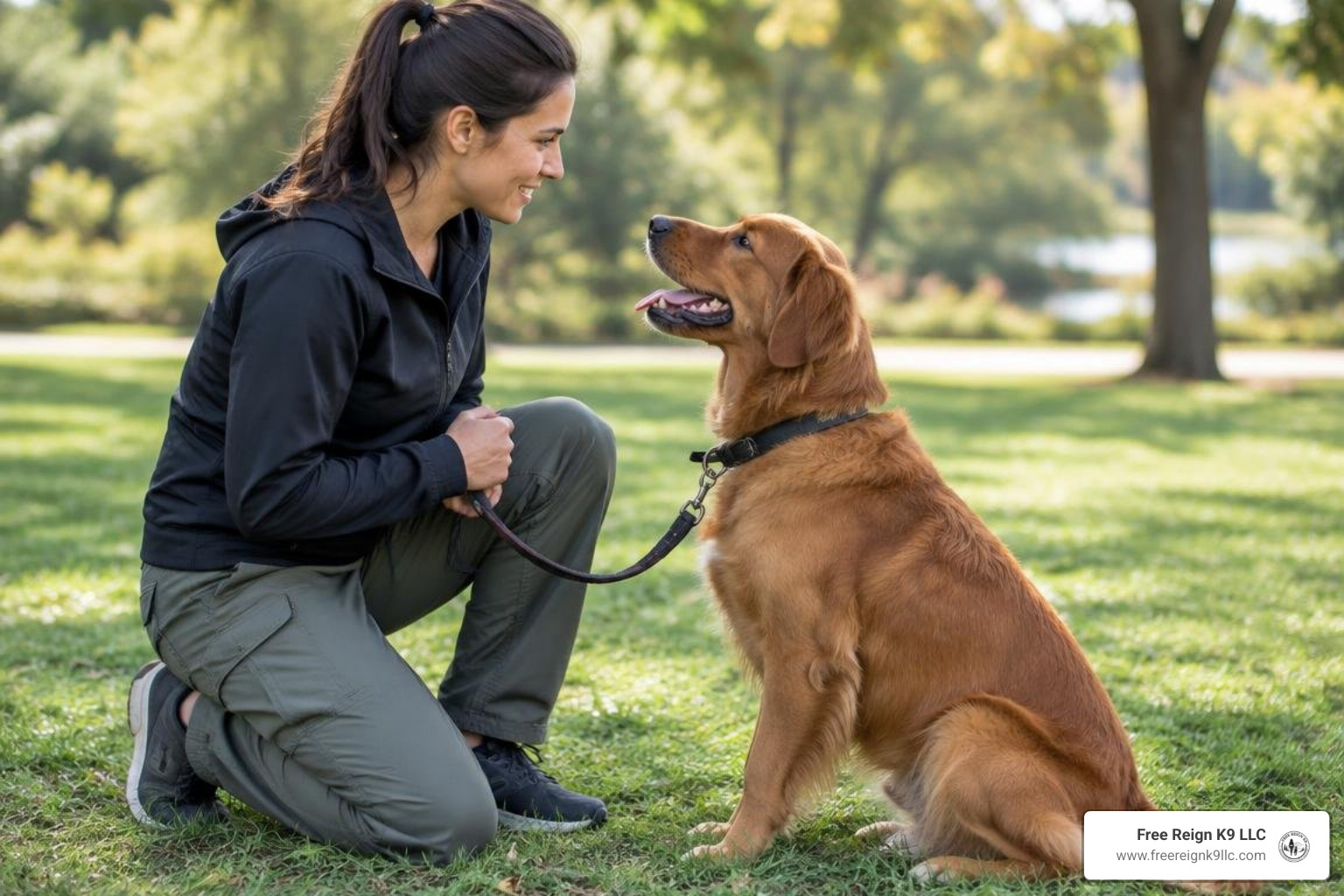
Before you ever unclip the leash in an open space, your dog needs clear impulse control and a solid communication system. The goal is an "invisible leash" built on mutual focus, respect, and clear expectations.
At Free Reign K9 LLC, we do not condone walking dogs with body harnesses, and we do not use anti-pull leashes. Harnesses encourage natural pulling reflexes, giving dogs leverage to ignore your guidance. Instead, we recommend a standard 6-foot braided leather leash as our best overall leash, specifically a standard 6-foot, 1/2-inch leash made from quality leather.
We use tools such as prong collars and e-collars to teach dogs through feedback. These tools provide gentle, unambiguous communication at a distance, ensuring your dog understands your expectations without confusion or panic. Grounding your pup's skills in veterinary guidance on off-leash training foundations ensures that physical health, safety protocols, and behavioral readiness align before taking your training outdoors.
Mastering Radius Training and Automatic Check-Ins
Radius training teaches your dog to monitor the distance between you and stay within an invisible bubble. Instead of constantly shouting commands, you teach your dog that drifting too far means turning around and catching up with you.
Start by walking in an open, low-distraction environment on a long line. Whenever your dog glances back at you or turns toward you without being cued, mark the behavior and reward them generously. If your dog wanders toward the edge of your acceptable boundary, immediately pivot 180 degrees and walk the other way without calling them. When they notice the distance opening up and run to catch up, praise and reward.
Young puppies between 7 and 14 weeks naturally follow owners and come when called due to early pack instincts. However, starting at 14 to 16 weeks, many begin exploring more and appear to forget their recall as their natural independence develops. Laying down radius foundations early keeps your dog checking in by habit, even as their curiosity peaks.
Building an Unbreakable Recall and Emergency Stop
A reliable recall is a life-saving safety cue. Following scientific recall training protocols ensures your dog learns to turn away from high-value distractions and sprint directly back to you every single time.
Never poison your recall cue. A poisoned cue happens when "Come" is repeatedly used to end fun, deliver baths, or administer medication, or when it is repeated five times while the dog blithely ignores you. Say your cue once in a clear, upbeat voice. Pair the return with your dog's favorite reward, whether that is real meat, a tug toy, or exuberant praise.
Alongside recall, teach an emergency stop or drop command. If your dog is moving toward an unexpected hazard, such as a drop-off or a passing vehicle, telling them to instantly sit or down at a distance is often safer than asking them to run back across the hazard zone.
Always condition a positive collar grab: reach for their collar, give a high-value treat, and release them back to play. This prevents your dog from playing keep-away when you reach for them. For handlers looking for hands-on guidance with these skills, one-on-one private lessons help refine timing and handler mechanics.
Step-by-Step Transition: From Leash Feedback to Total Reliability
Transitioning to off-leash reliability requires patience and progressive proofing. Many owners rush the process, dropping the leash after a few good days in the living room, only to watch their dog bolt after the first squirrel they spot on the trail.
Real-world reliability takes time. Indoor and backyard recall can be solid within 2 to 4 weeks of daily practice. Outdoor recall with moderate distractions typically takes 2 to 4 months of systematic work. Achieving true high-distraction proofing in stimulating outdoor environments often takes 6 to 12 months. Taking time to prepare dogs for outdoor adventure trails ensures that your companion is physically and mentally ready for the journey.
Step-by-Step Progression in Off-Leash Training for Dogs
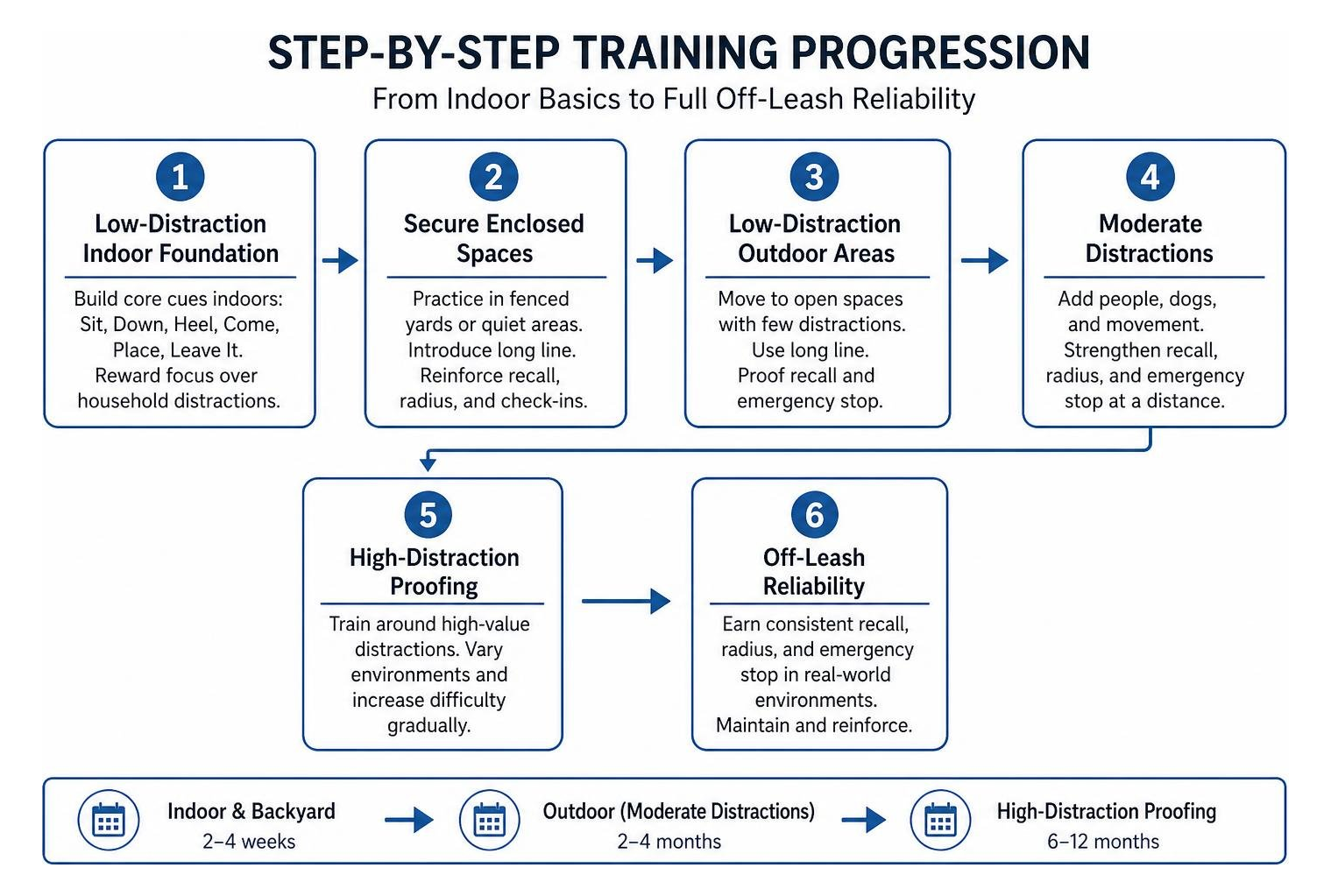
Moving through clear training phases keeps your dog confident and successful:
- Phase 1: Low-Distraction Indoor Foundation Build your core cues inside your home: Sit, Down, Heel, Come, Place, and Leave It. Reward your dog with high-value food and affection for choosing focus over household distractions.
- Phase 2: Secure Enclosed Spaces Move your practice to a fenced backyard or a private, fully enclosed outdoor area. Introduce distance and mild environmental distractions while maintaining high rates of reinforcement.
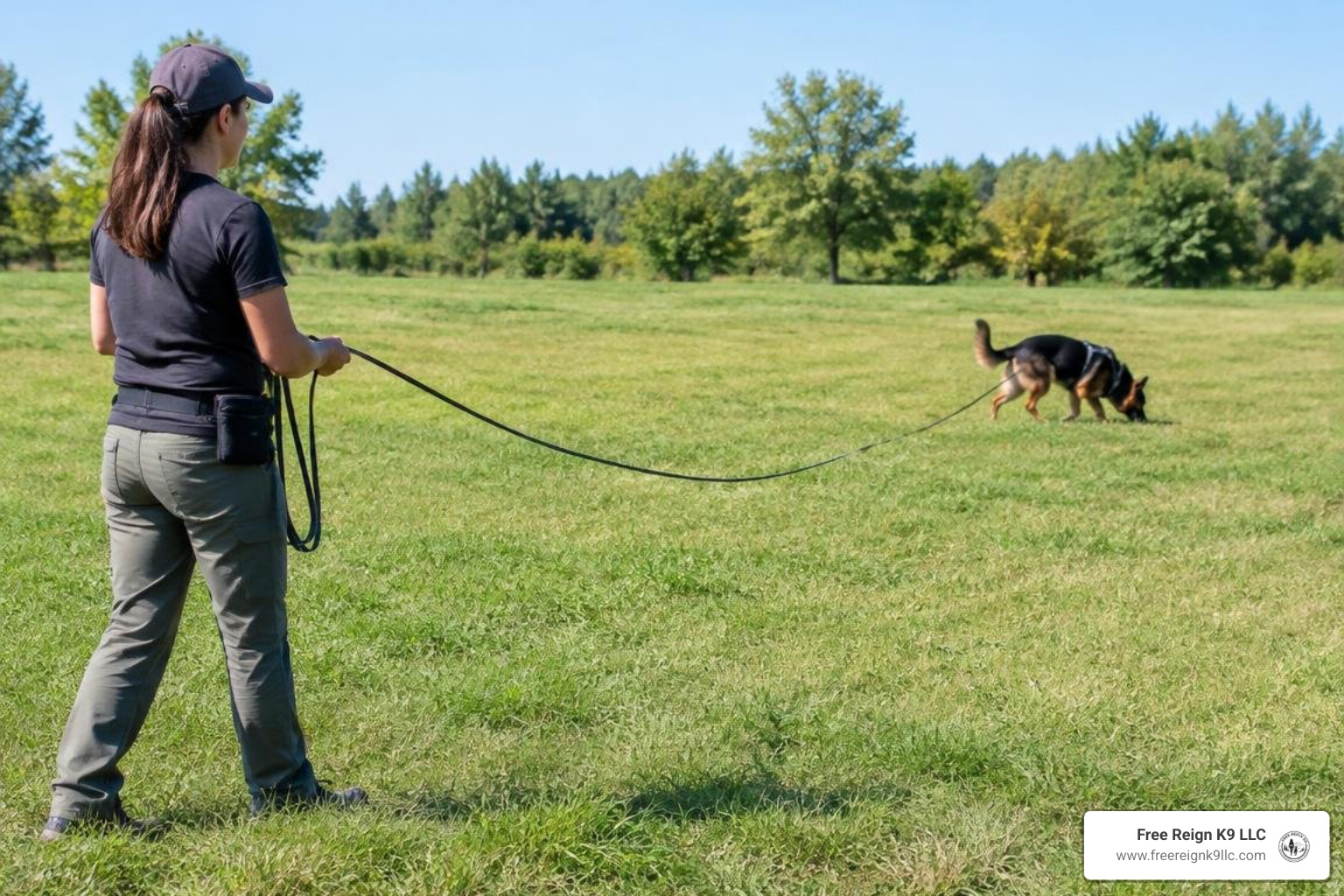
- Phase 3: Long-Line Outdoor Handling Step out into quiet outdoor parks using a 20 to 30-foot long line attached to your dog. Practice automatic check-ins, directional changes, and recalls. The line serves as a safety backup so your dog cannot practice ignoring cues.
- Phase 4: Trailing Line Transition Let the long line drag freely on the ground in open, permitted areas. You are no longer holding the leash, but you can step on it if needed. This bridges the psychological shift from handler tension to total freedom.
- Phase 5: Full Off-Leash Reliability Unclip the line in designated off-leash environments where legal and safe. Test commands in varied settings, always keeping training engaging. real-world proofing in challenging outdoor environments requires adjusting to rain, mud, wildlife scents, and steep terrain.
Safety Protocols, Distraction Management, and Risk Mitigation
Off-leash adventures carry real-world risks that every responsible handler must actively manage. Wildlife, sudden loud noises, aggressive approaching dogs, and terrain hazards can catch an unprepared dog off guard.
- Prey Drive Management: High-drive dogs require structured outlets and proofed "Leave It" commands before being trusted off-leash near deer, birds, or small critters.
- Identification & Technology: Always make sure your dog has up-to-date microchip information registered, a collar with clear identification tags, and a reliable GPS tracking collar for backcountry excursions.
- Eliminate On-Leash Greetings: Never allow your dog to greet unfamiliar dogs on-leash. On-leash greetings create frustration, mixed signals, and leash reactivity that undermine off-leash neutrality.
- Respect Leash Laws: Off-leash freedom is a privilege reserved for legal, safe areas. Keeping your dog leashed where mandated protects sensitive ecosystems, wildlife, and reactive dogs working with their owners nearby.
Our comprehensive canine training programs are built around these safety standards, helping dogs learn impulse control and handlers gain true confidence in their handling skills.
Common Mistakes in Off-Leash Training for Dogs and How to Avoid Them
Even dedicated dog owners run into training roadblocks. Avoiding these common mistakes will save you months of frustration:
- Poisoning the Recall Cue: Calling your dog to you only to clip on the leash, give a bath, or end playtime teaches them that returning brings a negative outcome. Recall them, reward them, and send them back to play.
- Repeating Commands (The Broken Record Trap): Saying "Come, come, rover, COME!" weakens your communication. Say your command once, and follow through with clear feedback if your dog hesitates.
- Unclipping the Leash Too Soon: Rushing off-leash freedom before proofing cues on a long line leads to lost control and dangerous situations.
- Inconsistent Handler Feedback: Allowing your dog to blow off commands on casual days while expecting perfection on adventure days creates confusion. Clear standards build reliable habits.
- Fading Rewards Completely: Many owners stop rewarding once a dog learns a cue. Off-leash reliability requires periodic, high-value surprise rewards throughout your dog's life to maintain motivation.
Frequently Asked Questions About Off-Leash Freedom
Navigating the journey to off-leash freedom brings up plenty of questions. For local insights, explore our frequently asked questions about dog training.
How long does it take to train a dog to be fully off-leash reliable?
Reliable off-leash training takes anywhere from 4 to 12 months of consistent, structured work. While basic commands can be learned in 2 to 4 weeks indoors, proofing those cues around real-world distractions like wildlife, other dogs, and novel outdoor environments requires steady exposure. Handlers must also manage adolescent regression between 6 and 18 months, reinforcing expectations calmly as dogs test boundaries.
Can all dogs achieve reliable off-leash freedom?
Not every dog is an ideal candidate for total off-leash freedom in open spaces. Dogs with extreme predatory drift, severe anxiety, or unaddressed dog-directed aggression require careful management for their own safety and the safety of the community. In these cases, using long lines in open fields or renting secure, private dog parks provides safe, enriched exercise without unnecessary hazards.
What should I do if my dog ignores a recall command outdoors?
Never chase your dog if they ignore your recall cue, as running after them turns the situation into a fun game of keep-away. Instead, stay calm, lower your body posture, make an exciting noise, and run in the opposite direction to trigger their natural chase drive back toward you. If your dog is dragging a long line, step on the line to stop their forward momentum, calmly reel them in, reward the check-in, and reset your training criteria to a less distracting environment.
Building Lifelong Adventure and Reliable Freedom
Off-leash training is not about showing off without a leash; it is about building deep, mutual communication and trust between you and your dog. When your dog knows their boundaries, understands clear feedback, and views you as their ultimate guide, daily walks turn into calm, stress-free adventures.
At Free Reign K9 LLC, our balanced training philosophy is designed to give you and your dog the freedom you have always wanted. By taking the time to build strong foundations, using the right leather leash and communication tools, and proofing behaviors step by step, you can step out onto any trail with complete confidence.