
Finding the Right Balance in Your Dog Training Strategy
Balanced Dog Training for Real-World Reliability
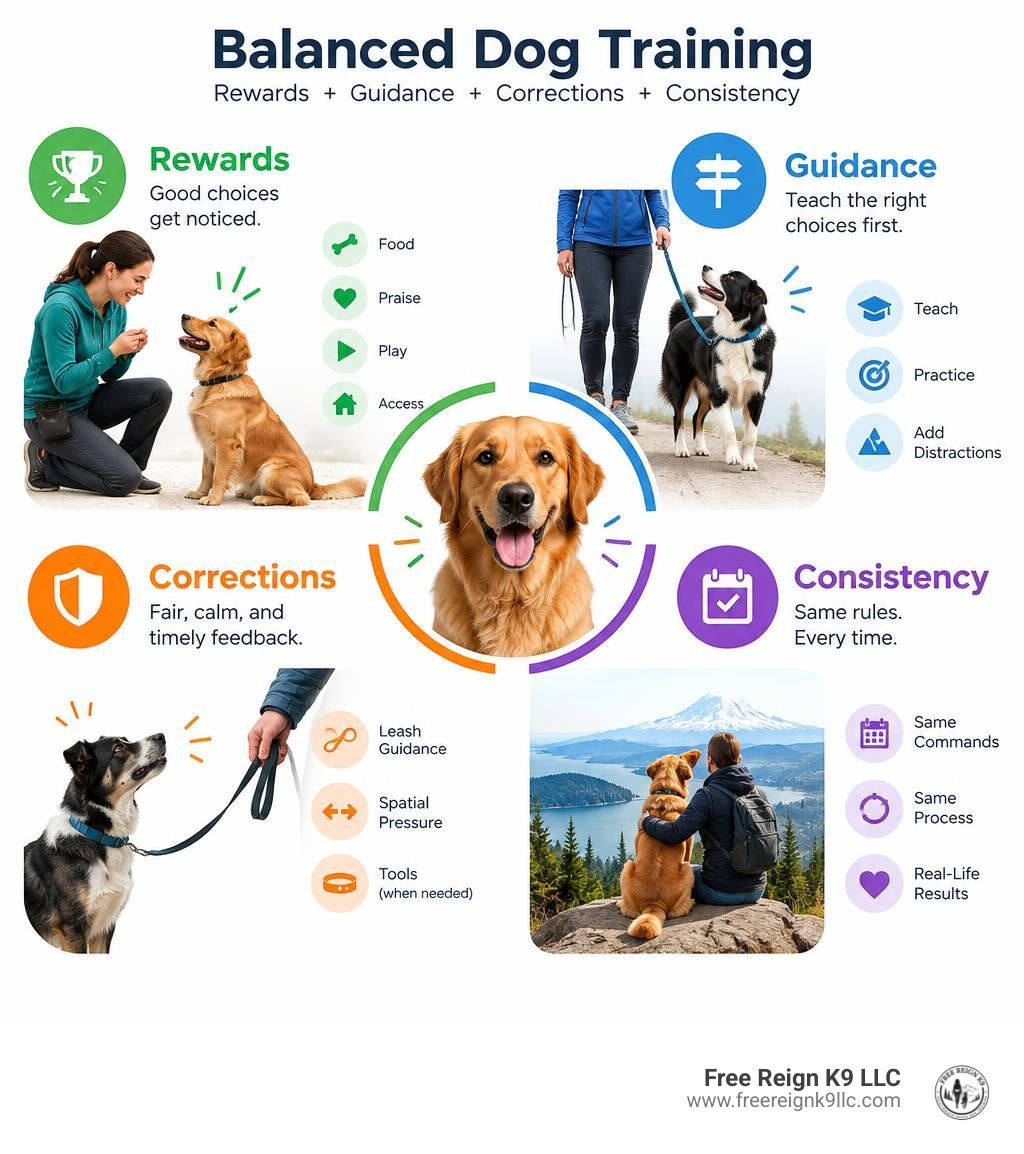
Balanced dog training combines rewards for the behaviors you want with fair, well-timed consequences for behaviors that are unsafe, unwanted, or ignored. The goal is not to punish a dog. It is to build clear communication, reliable obedience, and the freedom to enjoy everyday life together, from calm walks in Tacoma to off-leash adventures across the Pacific Northwest.
For busy dog owners, a balanced approach often means teaching both sides of the conversation:
- Reward good choices with food, praise, play, or access to what your dog wants.
- Clearly teach commands before expecting your dog to follow them around distractions.
- Use leash guidance, your position and movement, or training tools your dog has been gradually taught to understand when needed to reinforce commands they already know.
- Keep corrections calm, proportional, and immediately followed by an opportunity to make the right choice.
Balanced training draws on operant conditioning, which explains how consequences affect behavior. It can include rewards, guidance, and corrections. Free Reign K9 uses tools such as prong collars and e-collars to teach dogs through feedback, with an emphasis on education and proper use for each dog and situation. Proper fit, gradually teaching your dog what low-level tool feedback means, good timing, and professional instruction are important parts of that approach.
The right strategy depends on your dog's temperament, history, goals, and behavior challenges. A fearful dog, a high-drive adolescent, and a dog that pulls toward wildlife on a trail may each need a different plan. What they all need is clarity, consistency, and a handler they can trust.
I am Kim Blanton, a dog trainer with Free Reign K9 LLC in Tacoma, Washington, where I help owners build practical skills through balanced dog training and structured board-and-train programs. My focus is helping dogs and their people develop the obedience and confidence needed for a safer, fuller life together.
Understanding Balanced Dog Training and Operant Conditioning
To understand how balanced training works, start with what happens after your dog does something. Those outcomes can influence what they do next. This is called operant conditioning: dogs learn from the consequences of their actions.
While some approaches focus on rewards, balanced training uses both rewards and consequences. We put plenty of emphasis on rewarding the behaviors you want, while also giving clear feedback when your dog ignores a command they know or does something dangerous, such as chasing wildlife or bolting into traffic.
Using both "yes" and "no" is part of our approach to communicating with your dog. Clear, consistent feedback helps your dog understand what you expect and practice those skills in everyday life, whether you are walking along the waterfront in Gig Harbor or relaxing at an outdoor café in West Seattle.
| Training Approach | Primary Focus | Boundary Enforcement | Distraction Reliability | Freedom Level |
|---|---|---|---|---|
| Purely Positive | High-value rewards, redirection | Ignoring bad habits or avoidance | Moderate to low in high-drive moments | Limited off-leash safety |
| Balanced Training | High rewards paired with fair accountability | Clear corrections through voice and physical cues | Exceptional across all environments | True off-leash lifestyle freedom |
| Correction-Only Training | Pressure and physical correction | Heavy physical correction | High compliance, lower enthusiasm | Restricted confidence and drive |
Core Pillars of Balanced Dog Training
Our approach has four parts: helping your dog want to learn, giving clear cues, teaching them how to respond to pressure and its release, and following through on commands they know.
First, we build enthusiasm. We use food, toys, and praise to teach basic skills like sit, down, place, and heel. A marker word, such as "yes," tells your dog right away that they made the correct choice. Think of this as a shared language: you use consistent words and movements so your dog knows what each cue means.
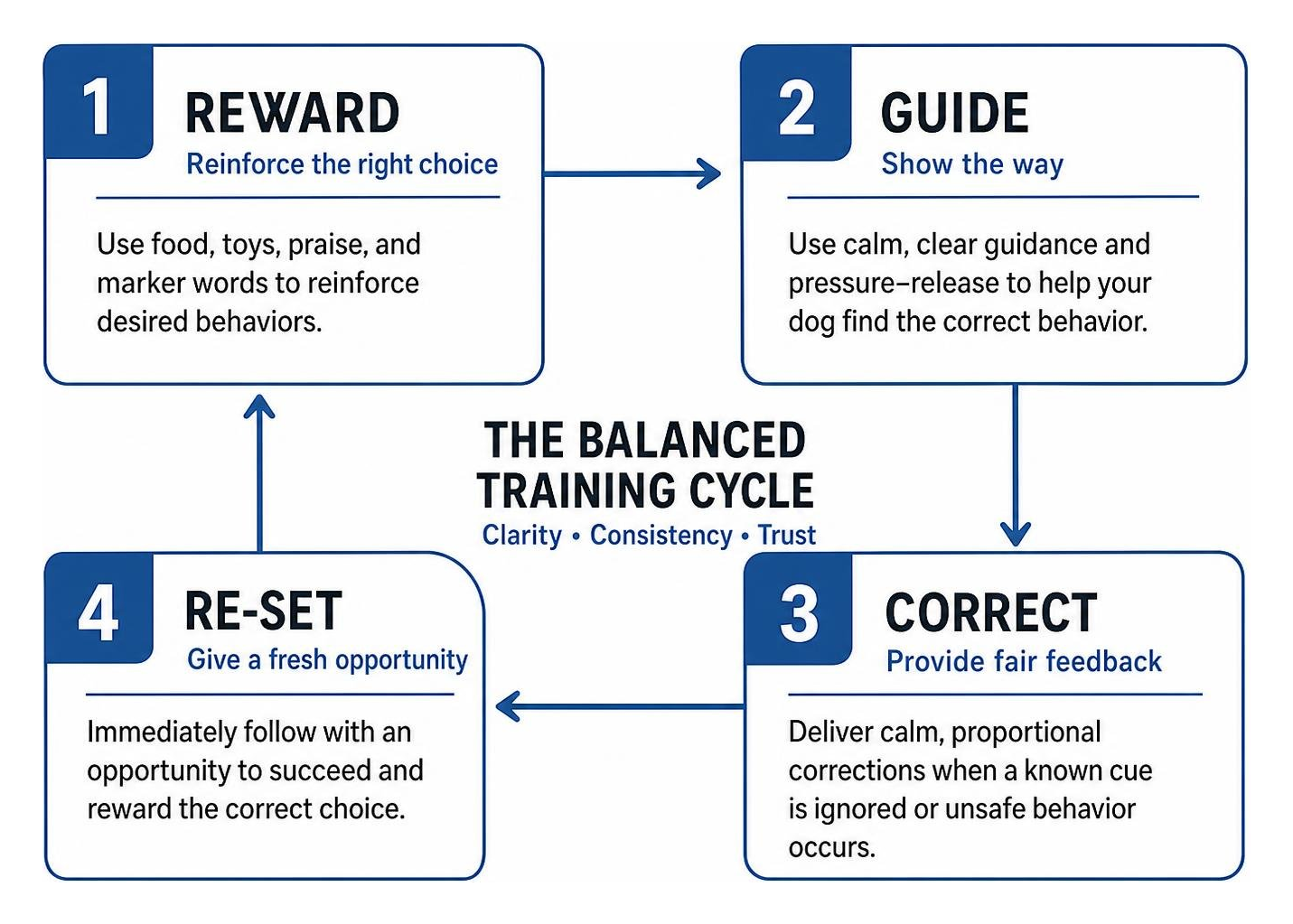
Second, we teach pressure and release. Gentle guidance with the leash or your position teaches your dog where to move; you ease that guidance as soon as they move into position. Once your dog understands the exercise, we calmly follow through on commands they know, even when a squirrel darts across the sidewalk in Fircrest or Normandy Park.
Balancing Motivation and Boundary Setting
If a previously rewarded behavior stops earning rewards, a dog may briefly try it more often or more intensely. A dog may also choose an exciting distraction over a treat, especially when they want to chase something. That is why practice around distractions needs to be gradual, rather than assuming a piece of chicken will draw your dog's attention away from a fleeing deer or another barking dog across the street.
Setting firm boundaries does not mean suppressing your dog's personality. It channels their natural drives constructively. By clearly defining what is acceptable and what is off-limits, we relieve the mental anxiety dogs experience when rules are inconsistent. For dogs struggling with fear, pushiness, or getting overly worked up, our dog behavior modification training establishes the structure necessary to restore domestic peace.
Essential Tools and Techniques for Clear Communication
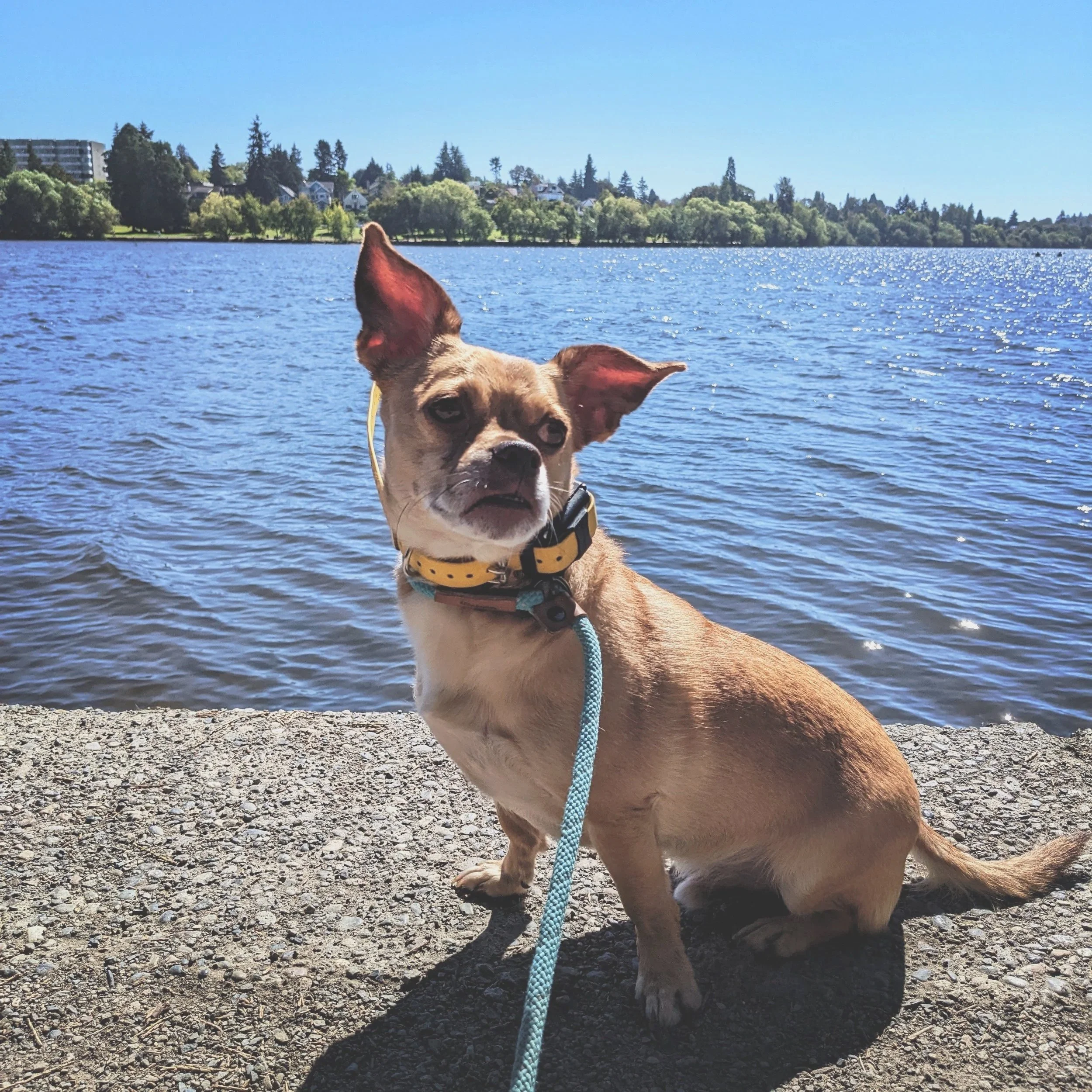
Good tools are only part of the picture. Learning when to give a cue and how to handle the leash can make practice clearer for both you and your dog.
The business recommends a standard 6-foot braided leather leash as its best overall leash. In fact, the business recommends a standard 6-foot, 1/2-inch leash made from quality leather for everyday handling, obedience drills, and neighborhood strolls. Free Reign K9 does not condone walking dogs with body harnesses. We do not use anti-pull leashes. Quality leather offers a secure, comfortable grip that protects your hands while delivering smooth, instantaneous communication to your dog's collar without the awkward tangling of synthetic materials.
Getting comfortable with leash handling takes practice. Look for hands-on dog-training instruction to learn when to give a cue, how your position guides your dog, and how to coordinate your movements during practice.
Effective Use of Modern E-Collars and Prong Collars
Prong collars and modern remote collars are often misunderstood. We use them to provide physical cues your dog has been taught to understand, with attention to fit, a gradual introduction, and the needs of your individual dog.
A prong collar applies pressure through contact points around your dog's neck. Fit and handling matter, and it should not be treated as a guarantee against pressure on the sensitive windpipe or against choking and gagging. Get professional guidance on whether it suits your dog and how to use it properly.
Modern e-collars let a handler give a cue at a distance. We gradually teach dogs what e-collar cues mean using low-level electrical stimulation. We use this cue to prompt recall and focus as dogs practice skills for outings, including trail hikes around Madison Park and Mercer Island. Dogs participating in our dog obedience training camps are introduced to these tools step by step, alongside rewards and practice. A tool alone does not guarantee off-leash safety.
Implementing Leash Pressure and Reward Schedules
We start teaching leash pressure somewhere with few distractions. We apply slight tension in one direction and release it as soon as your dog moves in that direction, then mark the correct choice with a word such as "yes" and offer a reward they enjoy.
- Luring and Shaping: Use food to guide your dog into position, or reward small steps toward the behavior you want.
- Introducing Leash Pressure: Pair gentle leash guidance with verbal cues your dog already knows.
- Varying Rewards: As your dog learns a behavior, move from giving a treat every time to rewarding some successful repetitions.
- Practicing Around Distractions: Gradually add challenges, from quiet backyards to busy parks in Magnolia.
If you want personalized support learning when to give cues and how to handle the leash, our dog private individual training lessons give you direct coaching tailored to your routine.
Evaluating the Benefits, Safety, and Common Misconceptions
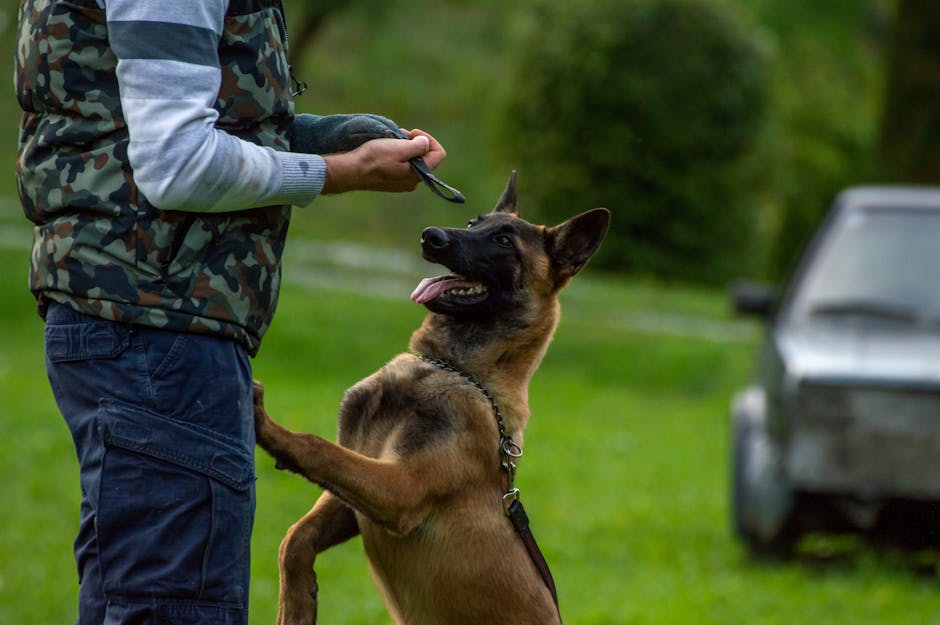
Clear communication creates calm dogs. When dogs know their boundaries, their stress levels drop. They no longer need to make difficult choices in complex environments because they trust their handler to guide them.
Determining if Balanced Dog Training Fits Your Dog
Every dog is an individual, with inherited tendencies such as a strong urge to chase, past experiences, and their own energy level. We tailor balanced training to the dog in front of us and your goals, including the needs of:
- High-Drive Working Breeds: Shepherds, Malinois, and hunting dogs that need clear boundaries alongside rewards and activities they enjoy.
- Leash Reactive Dogs: Dogs barking or lunging out of frustration or insecurity who need clear directional guidance.
- Family Companions: Everyday pets in Clyde Hill, Browns Point, or Redondo needing polite manners around children and guests.
- Adventurous Hikers: Dogs working toward reliable off-leash recall across unpredictable terrain.
Our diverse programs & services are built around your specific lifestyle goals, whether you need on-leash manners or advanced trail reliability.
Addressing Common Myths and Safety Concerns
A widespread myth suggests that balanced training damages the bond between dog and owner. In reality, dogs thrive on clarity. Anxiety often stems from mixed signals, where an owner pleads or bribes an overstimulated dog without providing clear direction.
When introducing tools, we use low levels the dog has been taught to understand and pay attention to their body language and willingness to participate. Proper tool use is never about anger or frustration. Our focus is calm, consistent guidance, with adjustments for your dog's needs.
Frequently Asked Questions About Dog Training Strategies
Navigating training methods can feel overwhelming for dog owners. To help you make the best decision for your home, explore our frequently asked questions dog training in Seattle or review the common inquiries below.
What is the primary difference between balanced and purely positive training?
Reward-based training focuses on rewarding the behaviors you want and withholding rewards or redirecting when unwanted behavior occurs. Balanced training also uses rewards to teach skills, but includes corrections for commands your dog already knows. A distraction may excite your dog more than a food reward interests them, so practicing gradually around distractions matters whichever approach you use.
Are prong collars and e-collars safe when introduced properly?
Proper fit and a careful introduction that teaches your dog what each cue means are important, but they do not make these tools risk-free. Modern e-collars deliver adjustable electrical stimulation; the settings vary by model. Prong collars apply pressure through contact points around the neck. Free Reign K9 emphasizes education and safe, proper use based on your individual dog and situation. Seek professional guidance rather than assuming either tool is suitable for every dog.
How long does it take to achieve off-leash reliability?
Timeline depends on your dog's temperament, age, starting foundation, and your consistency at home. Most dogs develop strong on-leash manners within a few weeks, while dependable off-leash recall around severe distractions generally takes between four to eight weeks of dedicated, structured practice.
Achieving Real-World Freedom and Reliable Obedience
True freedom for your dog is not about removing all rules. It is about building a rock-solid foundation of obedience that allows you to safely include them in your everyday adventures. When your dog reliably recalls away from distractions, heels politely past passing dogs in Burien, and rests quietly on their place mat during family dinners, their world expands.
At Free Reign K9 LLC, we help owners across Medina, Hunts Point, Yarrow Point, and North Tacoma unlock that reliable lifestyle. By pairing high-value rewards with clear boundaries, we give you the tools and handling skills needed for lifelong success.
Ready to transform your daily walks and unlock real off-leash freedom? Visit Free Reign K9 LLC or contact us for dog evaluation today to begin your journey toward a well-mannered companion.