
Understanding the Schnauzer Mindset: Why Breed-Specific Training Matters
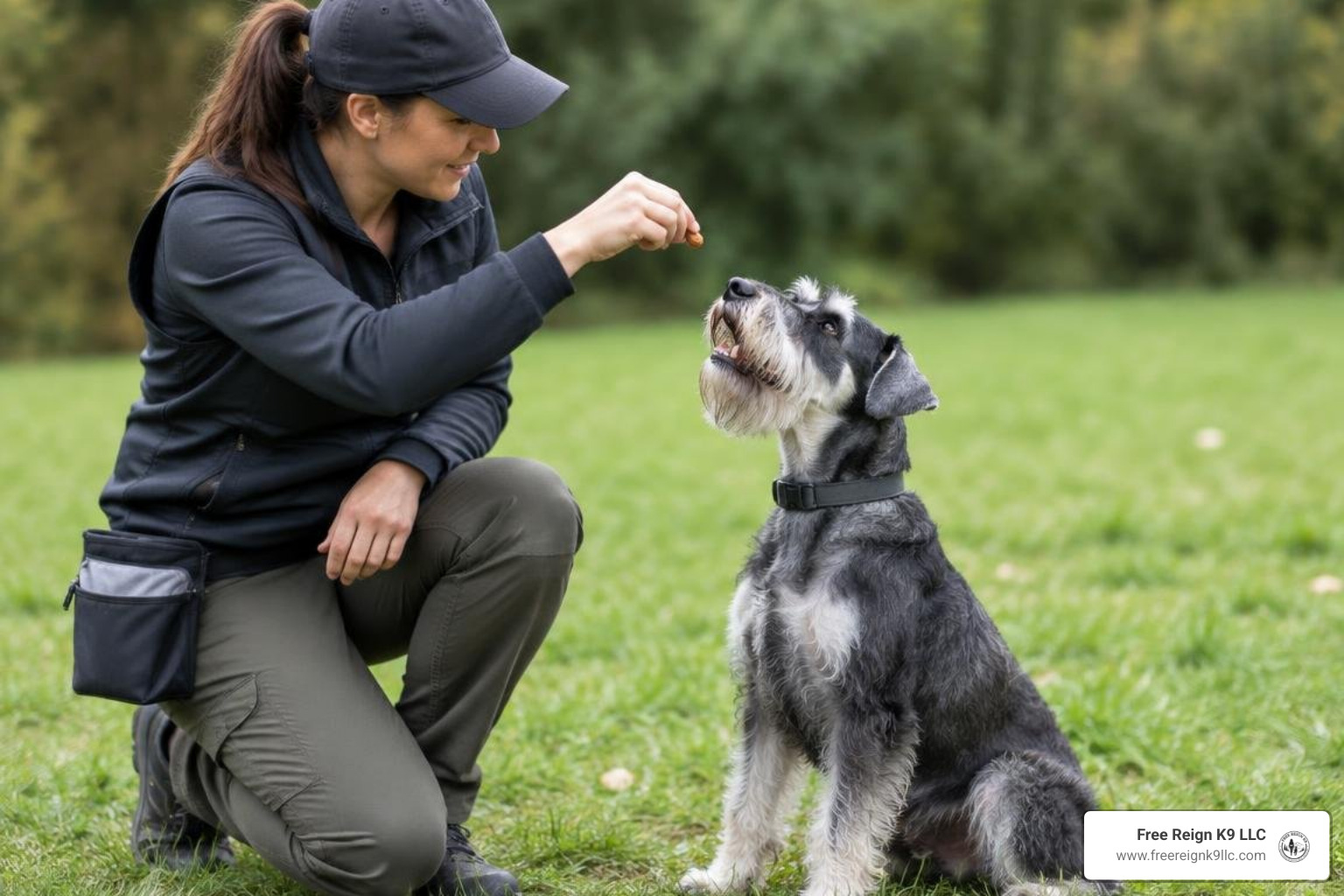
To choose the right Schnauzer obedience training class, match the format to your dog's behavior needs, screen trainers for terrier or working-breed experience, and confirm that positive reinforcement and clear boundaries are part of the curriculum. A class that is too generic may bore this intelligent breed, while a program that ignores their watchdog and prey instincts can leave everyday behaviors unmanaged. Once you have those criteria in mind, it helps to understand the purpose for which Schnauzers were originally bred. Originating in Germany, Schnauzers served as versatile farm dogs, vermin hunters (ratters), and vigilant guardians. Miniature Schnauzers hold a solid trainability rating of 8/10 and sit at #22 in AKC popularity, while Standard Schnauzers share an 8/10 trainability score and rank #67.
Despite their high intelligence, Schnauzers are not robotic repeaters like some sporting or herding breeds. They possess a keen problem-solving mind and an innate drive to assess their surroundings. If a training session feels monotonous or pointless, an independent Schnauzer will readily decide to entertain themselves elsewhere.
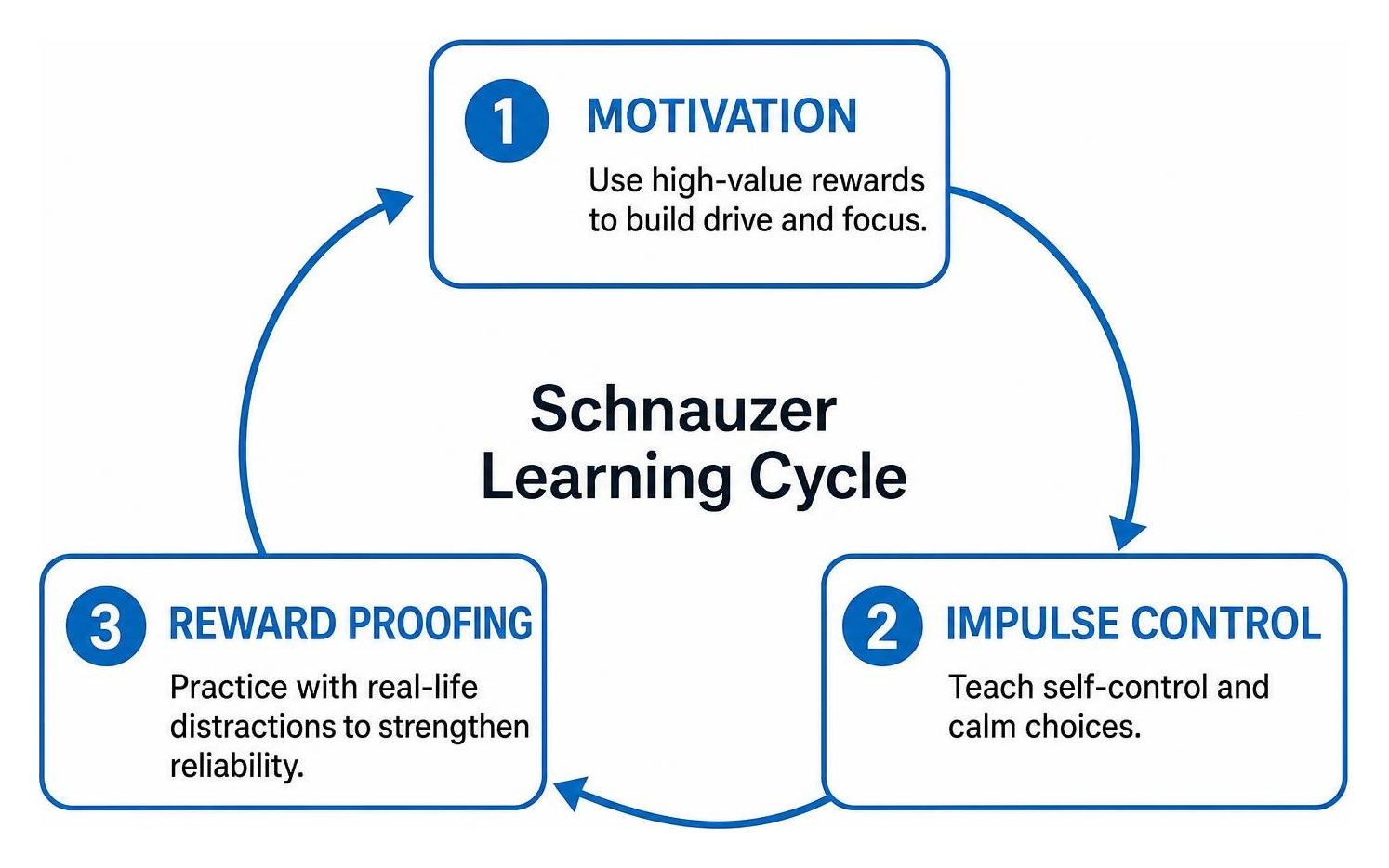
When you work with your Schnauzer, positive reinforcement and high-value rewards (such as freeze-dried liver, diced chicken, or tug play) help your dog learn new skills, as supported by veterinary behavior guidelines from the American Veterinary Society of Animal Behavior (AVSAB). Resources like the Standard Schnauzer Training Guide: Puppy & Adult Dog Training Tips and breed guides from Lyka Blog emphasize keeping sessions short and mentally engaging to help prevent boredom.
Managing Alert Barking and Stubbornness
Schnauzers take their historical watchdog duties seriously. Their expressive eyebrows and distinguished beards often accompany a sharp, piercing alarm bark at the slightest change in the environment, from a delivery truck down the street to a neighbor walking past the window.
Calling your Schnauzer "stubborn" can overlook their natural independence. Clear motivation and consistent boundaries give you a more useful starting point. To manage alert barking:
- Acknowledge and Redirect: Allow one alert bark to acknowledge their notification, then give a "Quiet" cue.
- Reward Silence: Say "Yes" the moment your dog is quiet and makes eye contact, then give a high-value treat.
- Teach Self-Control: Practice a "Place" cue so your dog learns to settle on a designated bed or mat before visitors enter.
- Avoid Shouting: Keep your voice calm rather than adding to the commotion.
Channeling High Prey Drive and Building Recall
Both Miniature and Standard Schnauzers retain a relentless instinct to chase small animals. A scurrying squirrel or neighborhood rabbit can instantly hijack their attention, making outdoor off-leash obedience a major safety hazard without proper preparation.
To build a reliable recall, or coming when called:
- Keep practice safely controlled: Use a 15- to 30-foot long line in open areas to give your dog room to move while keeping them safely attached to you.
- Make coming to you rewarding: Pair your recall cue with jackpot rewards, such as a rapid sequence of tasty treats or an energetic game of chase-the-toy away from the distraction.
- Practice with gradually increasing distractions: Start indoors without distractions, move to a quiet backyard, then practice at a neighborhood park on the long line. Only consider off-leash practice in securely fenced enclosures.
Comparing Formats for Schnauzer Obedience Training
Selecting the ideal format depends heavily on your lifestyle, your dog's current behavior challenges, and how much hands-on coaching you need. Our team at Free Reign K9 provides a structured path forward through our comprehensive training programs and services.
| Training Format | Best Suited For | Key Advantages | Potential Drawbacks |
|---|---|---|---|
| Group Classes | Puppies and social dogs needing basic cue practice | Direct exposure to other dogs; cost-effective | Distraction level can overwhelm reactive dogs; generic pacing |
| Private Lessons | Handlers needing 1-on-1 coaching for specific home/leash habits | Tailored pace; resolves specific household problems | Requires significant daily homework and owner time commitment |
| Board-and-Train Camps | Busy owners, intensive obedience, off-leash practice around distractions | Daily professional immersion; fast skill foundation | Requires strict owner follow-through to maintain routines at home |
When to Choose In-Person Schnauzer Obedience Training Camps
For busy owners seeking clear, reliable obedience without the trial-and-error phase, immersive programs offer tremendous value. In our Dog Obedience Training Camps, dogs live with professional trainers in structured environments, mastering reliable leash manners, impulse control, and solid recall around real-world distractions before returning home with an extensive handler transfer session.
Private Lessons for Focused Handler Coaching
If you want to be your dog's main hands-on teacher with expert guidance, one-on-one instruction may be a good fit. Through our Dog Private Individual Training Lessons, we coach you step-by-step on how to handle the leash, how to signal when your dog gets something right, and how to address unwanted habits in your home or neighborhood.
Specialized Behavior Modification for Reactivity
If your Schnauzer struggles with leash reactivity (strong reactions to dogs or people while on leash), frustration behind fences or other barriers, or resource guarding (protecting food, toys, or other valued items), a standard obedience class may be stressful. Our targeted Dog Behavior Modification Training lets us work on desensitization and counter-conditioning: gradually helping your dog become more comfortable with triggers and build positive associations with them.
Core Curriculum to Look for in a Quality Course
A complete Schnauzer training course should go beyond tricks and help you and your dog build practical skills for everyday life:
- Name Response & Engagement: Practicing eye contact when you call your dog's name, including around nearby sights and smells.
- Reliable Sit/Stay and Down/Stay: Teaching your dog to stay in position for longer periods and while you move farther away, building patience and self-control.
- The "Place" Command: Teaching your dog to stay on a designated bed or mat to help manage pacing, door-dashing, and begging.
- Loose-Leash Walking: Teaching your dog to respond to leash pressure and walk politely beside you without pulling ahead or lunging.
- Leave It & Drop It: Practicing safety cues to help your dog disengage from something they want to chase or pick up, or release something in their mouth.
- Crate & House-Training Routines: Consistent routines for crate use and bathroom breaks.
- Getting Comfortable with Handling and Grooming: Helping your dog accept paw-touching, ear cleaning, and daily beard maintenance.
At Free Reign K9 LLC, we do not condone walking dogs with body harnesses, and we do not use anti-pull leashes. Our best overall leash recommendation is a standard 6-foot, 1/2-inch braided leash made from quality leather.
Puppy Foundations vs. Adult Schnauzer Obedience Training
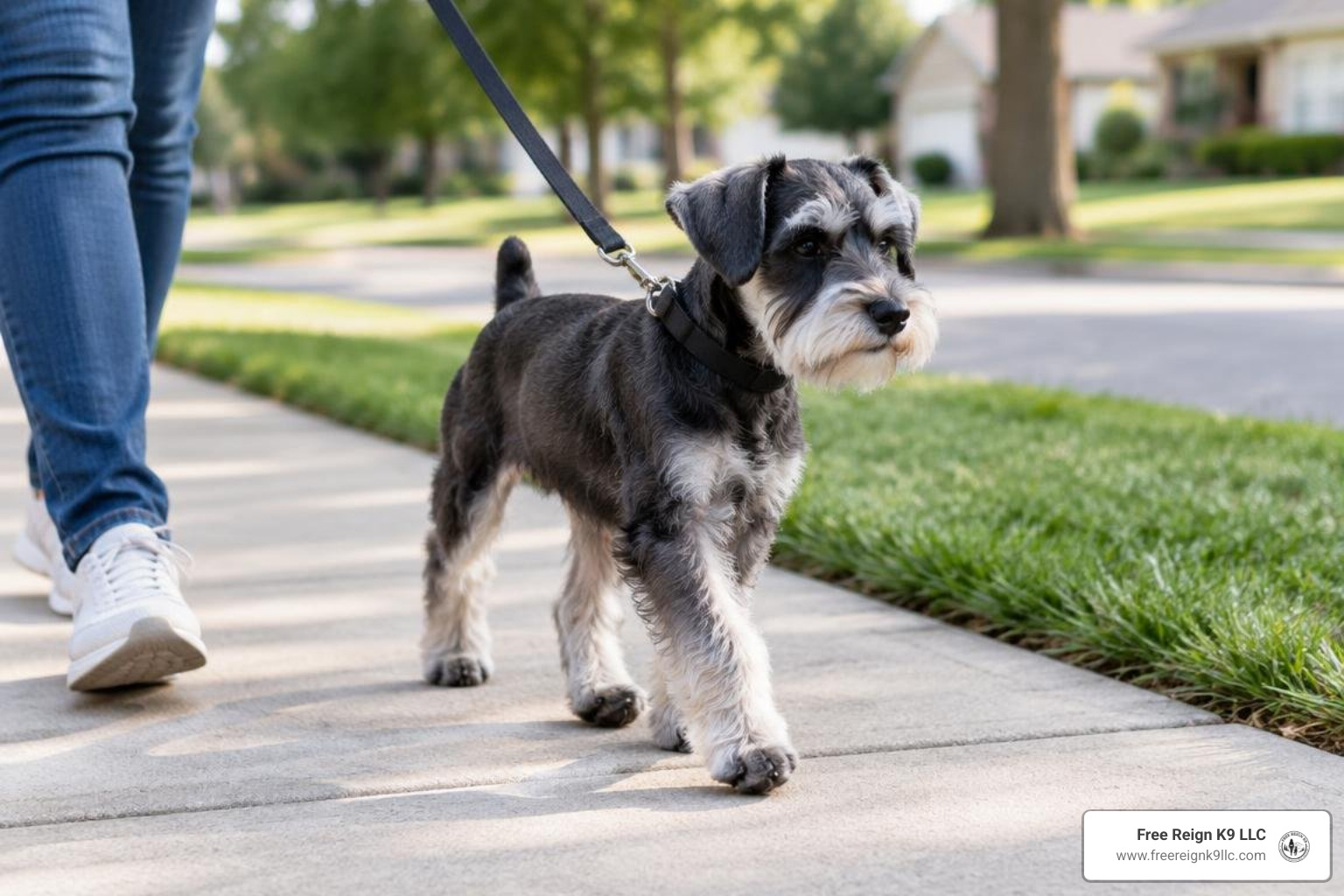
Starting early helps you build everyday habits with your puppy. Between 8 and 16 weeks of age, focus on positive socialization, crate comfort, bite inhibition (learning to control how hard they mouth or bite), and short 5-minute learning games. For step-by-step weekly plans, explore TailorPup's Miniature Schnauzer Guide, their Standard Schnauzer Guide, and general breed guides like EatHealthy365.
If you are training an adult Schnauzer, the focus shifts to unlearning established bad habits, sharpening focus around distractions, and providing mental outlets to prevent boredom-induced behaviors.
How to Screen Trainers and Training Philosophies
When choosing an obedience program or trainer, look for clear communication, transparent methods, and a balanced approach that pairs rewards for good behavior with clear boundaries. At Free Reign K9 LLC, our balanced approach includes owner education and the safe, proper use of training tools chosen for each dog and situation. We use tools such as prong collars and e-collars (electronic training collars) to teach dogs through feedback.
Use this checklist during your initial screening:
- Do they have verifiable experience working with terrier or working breed drives?
- Do they incorporate owner education and transition lessons into their programs?
- How do they address high-distraction environments and prey drive?
- Do they maintain clean, structured facilities with clear safety measures?
For more details on our process and what to expect during instruction, browse our frequently asked training questions.
Frequently Asked Questions About Schnauzer Training
At what age should I start formal obedience training for my Schnauzer?
You should begin foundation training the very day you bring your 8-week-old puppy home. Focus first on name recognition, crate training, housebreaking schedules, and positive handling. Formal obedience cues (sit, down, place, loose-leash walking) can easily be introduced in short, 3- to 5-minute sessions using their daily meal kibble as rewards.
Why does my Schnauzer ignore commands they already know?
Schnauzers rarely fail to respond out of spite. In most cases, the failure comes down to one of three factors: the distraction level is too high for their current stage of learning, the reward offered does not match the difficulty of the task, or the training session has gone on too long and the dog is mentally fatigued. Lower the distraction level, increase reward value, and keep sessions brief.
How much daily exercise and mental stimulation do Schnauzers require?
Miniature Schnauzers need approximately 45 to 60 minutes of daily physical exercise paired with 15 to 30 minutes of mental stimulation (puzzle feeders, scent games, obedience drills). Standard Schnauzers, as active working dogs, require an hour or more of vigorous physical activity along with structured tasks or canine sports to keep their minds balanced and calm indoors.
Setting Your Schnauzer Up for Lifelong Success
Schnauzers are remarkably clever, loyal, and spirited companions. When you channel their natural watchdog vigilance and hunting instincts into structured obedience, you unlock the full potential of this distinguished breed. At Free Reign K9 LLC, our balanced training philosophy bridges the gap between structured discipline and real-world freedom, giving you a reliable, confident companion in any setting.
Ready to transform your dog's manners and build a lasting partnership? Visit our training consultation page to get started today.