
Start Puppy Obedience Training With Simple Daily Wins
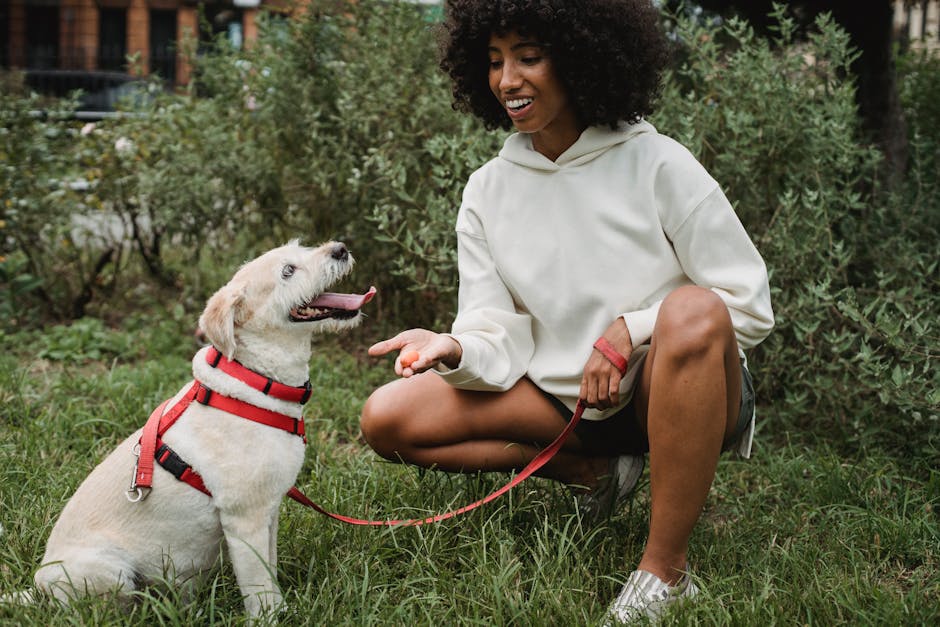
Start puppy obedience training on the first day home. Focus on a predictable potty routine, a crate that feels safe, name recognition, gentle handling, and rewarding calm behavior. Keep lessons short - about 3 to 5 minutes - and reward the right choice right away with food, praise, play, or access to something your puppy wants.
The first few months matter because puppies are learning what is safe, normal, and worth repeating. Build skills before problems become habits:
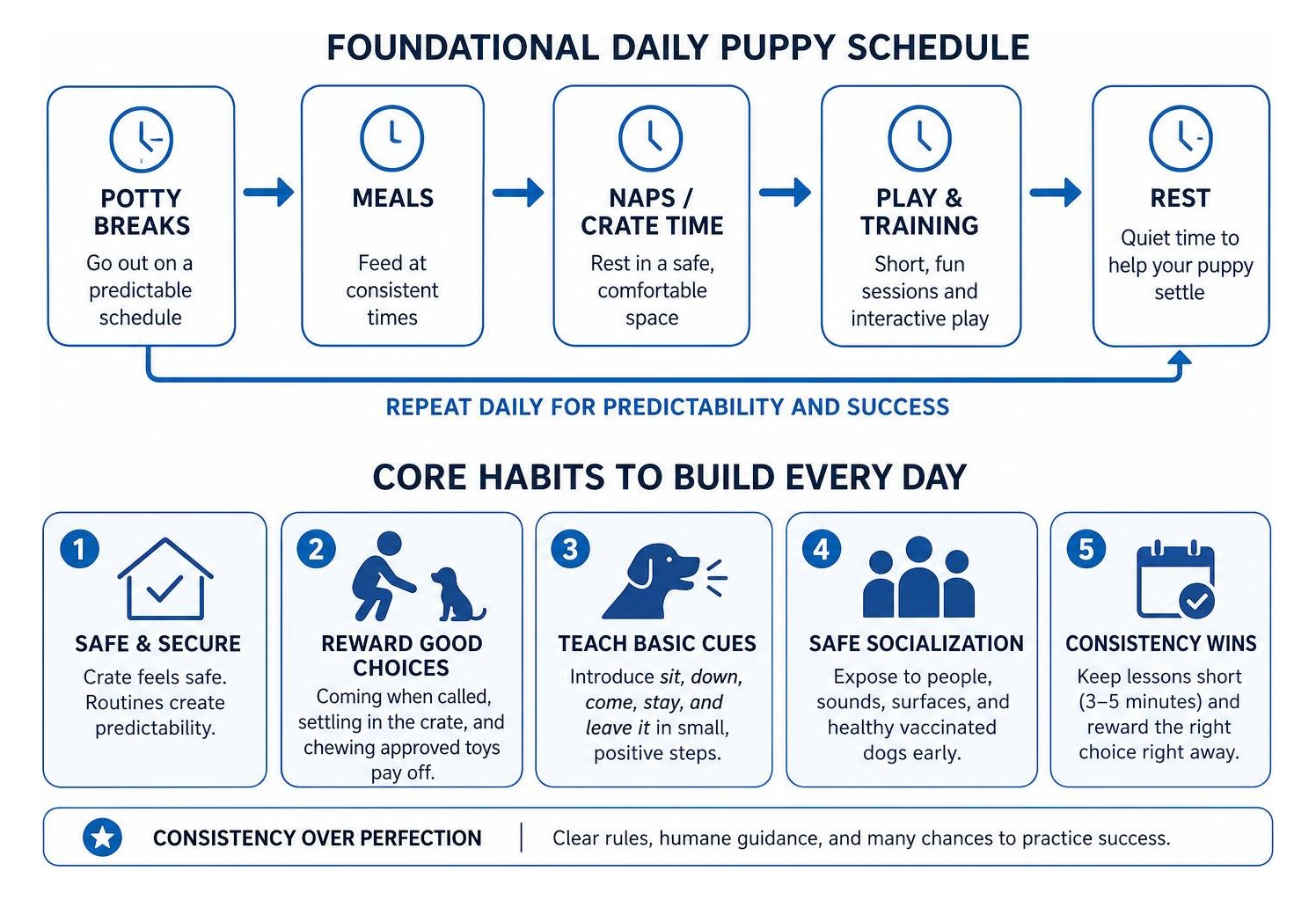
- Set regular times for potty breaks, meals, naps, play, and rest.
- Teach your puppy that coming to you, settling in the crate, and chewing approved toys pays off.
- Introduce basic cues such as sit, down, come, stay, and leave it one small step at a time.
- Provide safe, positive exposure to people, sounds, surfaces, and healthy vaccinated dogs before the early socialization window closes.
Consistency beats long training sessions. A puppy does not need perfect obedience right away; they need clear rules, humane guidance, and many chances to practice success.
I am Kim Blanton, a dog trainer with Free Reign K9 LLC in Tacoma, Washington, where I help owners build reliable puppy obedience training habits through clear communication, structure, and humane training. Next, we will cover the essential routines that help a new puppy feel secure and ready to learn.
Essential Foundations for Puppy Obedience Training
Bringing home a young dog brings endless excitement and, inevitably, a fair amount of chaos. When families ask us what are the first things you should teach a puppy?, our answer always centers on establishing daily structure over practicing complicated tricks.
A predictable routine helps your puppy know what to expect. Set regular times for meals, sleep, potty breaks, and play together to make daily life easier for both of you. Between 8 and 16 weeks of age, your puppy is learning about the world around them. Gentle boundaries, a safe place to rest, and reliable routines from day one can help you build good habits.
If you live in Seattle, Madison Park, Magnolia, or West Seattle, establishing this balance early sets your companion up for real-world reliability. For busy households needing structured guidance during this critical window, our dedicated Puppy Head Start Programs offer an ideal path toward long-term confidence and manners.
Crate Training, Potty Routines, and Safe Socialization
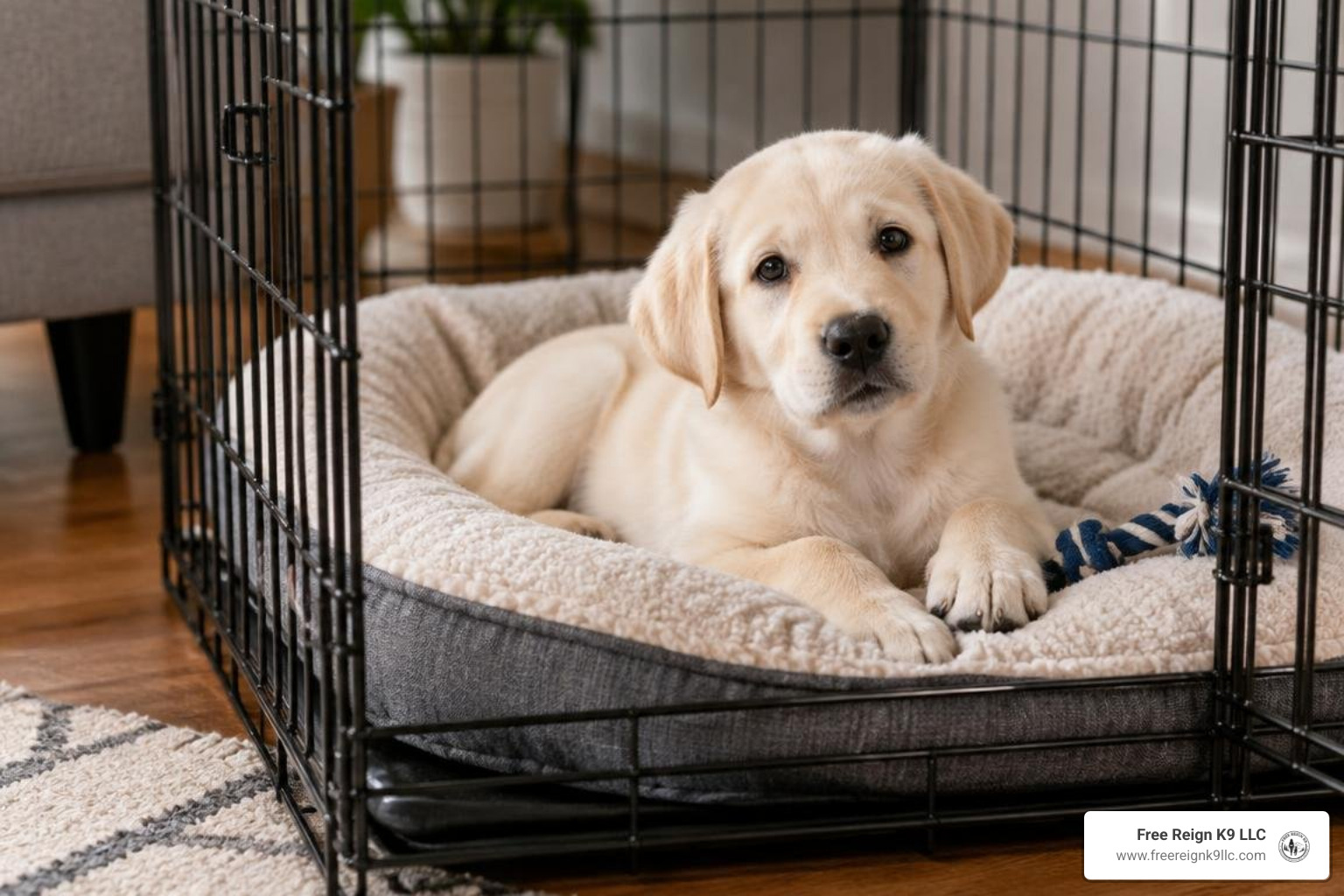
A crate can give your puppy a comfortable place to rest and help with potty training, since puppies generally prefer not to soil their sleeping space. Choose a crate large enough for your puppy to stand up, turn around, and lie down comfortably. If it is too spacious, they may use one corner for sleeping and another as a bathroom.
To build a reliable potty schedule, take your puppy outside:
- Immediately upon waking up in the morning or after naps
- Within 10 to 20 minutes following every meal
- Immediately after vigorous indoor play sessions
- Every 1 to 2 hours during normal waking periods
When your puppy eliminates in the designated outdoor area, reward them immediately on the spot with verbal praise and a small treat within 1 to 2 seconds. Waiting until you walk back inside disconnects the reward from the action in your dog's mind.
According to guidelines from the American Veterinary Society of Animal Behavior (AVSAB), early socialization should take place before 12 to 16 weeks of age. Waiting until vaccinations are complete at 16 weeks can mean missing an important time for your puppy to learn about the world.
Socialize safely by keeping your puppy off public ground where unvaccinated dogs gather. Introduce them to new sights, traffic sounds, umbrellas opening, household vacuum sounds, and calm, fully vaccinated adult dogs in controlled, clean environments. For variety, try introducing your puppy to 7 different surfaces, 7 safe locations, and 7 friendly new people. Keep each experience positive and follow your veterinarian's guidance on health precautions.
Managing Mouthing, Biting, and Alone-Time Independence
Puppies explore their surroundings with their mouths. Those sharp teeth can test your patience, but mouthing is an opportunity to teach bite inhibition, or control over how hard they bite, and help them use their mouth gently.
When your puppy bites too hard during play:
- Give a brief, calm, high-pitched "yip" or "ouch."
- Stop moving for a few seconds to teach them that biting too hard ends the fun.
- Redirect their attention right away to an appropriate rubber toy, rope, or hollow chew stuffed with frozen kibble.
Puppies chew aggressively during teething phases, making appropriate outlets essential. Stuffed enrichment toys keep jaws busy and burn mental energy.
Teaching alone-time independence prevents separation-related distress down the road. Start departures on day one. Place your puppy in their crate or a secure exercise pen with an engaging chew toy, walk out of the room for two minutes, and return before they show signs of distress. Gradually expand these departures to 5, 15, and 30 minutes. Rewarding quiet settling teaches your puppy that your departure is routine and your return is guaranteed.
Core Commands and Progressive Skill Milestones
Clear communication helps your puppy learn. We use a marker, such as the word "Yes!" or a clicker sound, to tell your puppy the moment they get it right, then immediately give a treat.
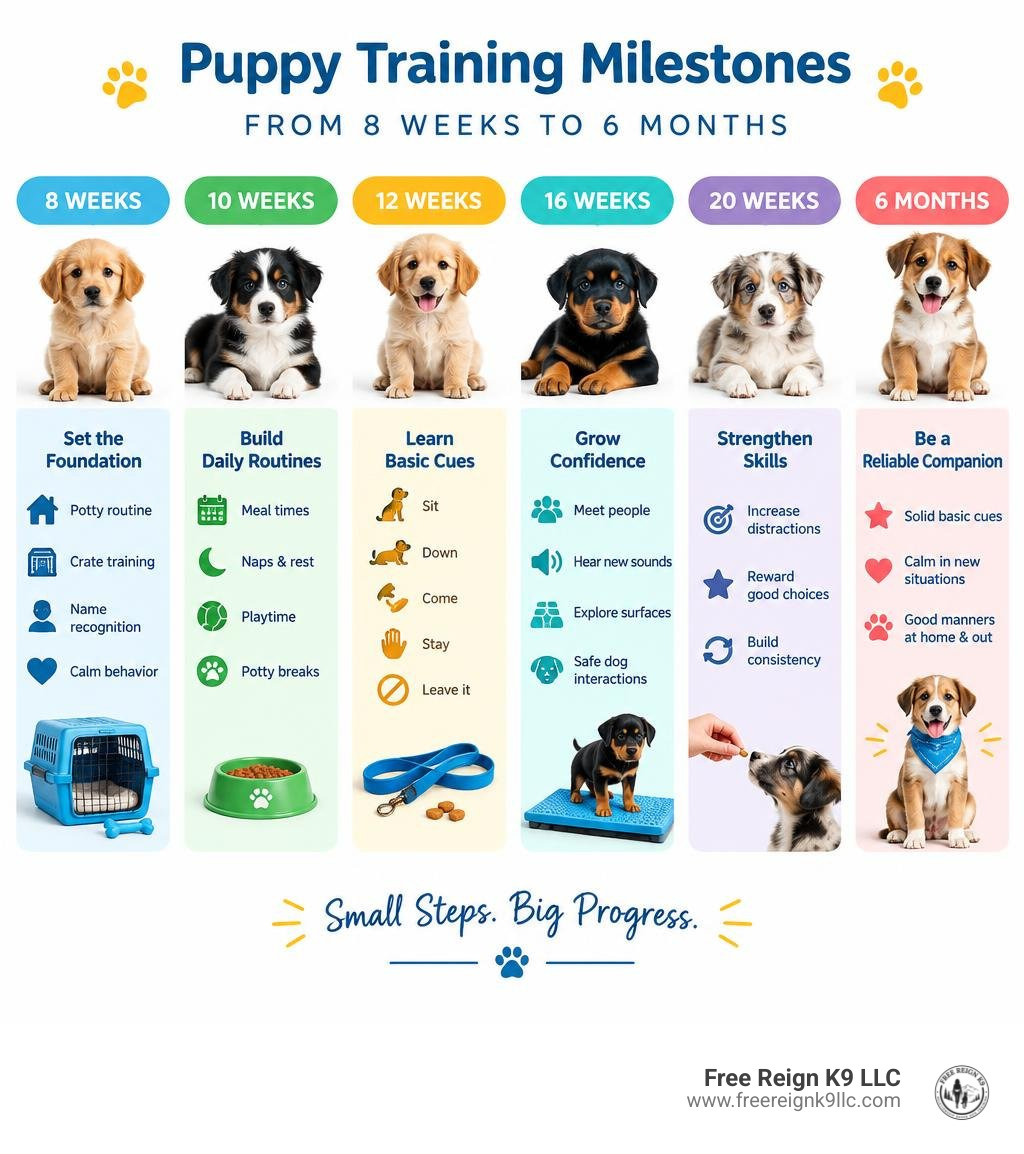
A step-by-step plan, such as Puppy Training 101: A Week-by-Week Guide (8 Wk to 6 Mo), can help you focus on the basics before asking your puppy to tackle more difficult tasks.
Step-by-Step Puppy Obedience Training for Core Commands
Keep training sessions to 3 to 5 minutes, running two to three times daily. Short, enthusiastic games yield far better focus than long, exhausting drills.
1. Sit
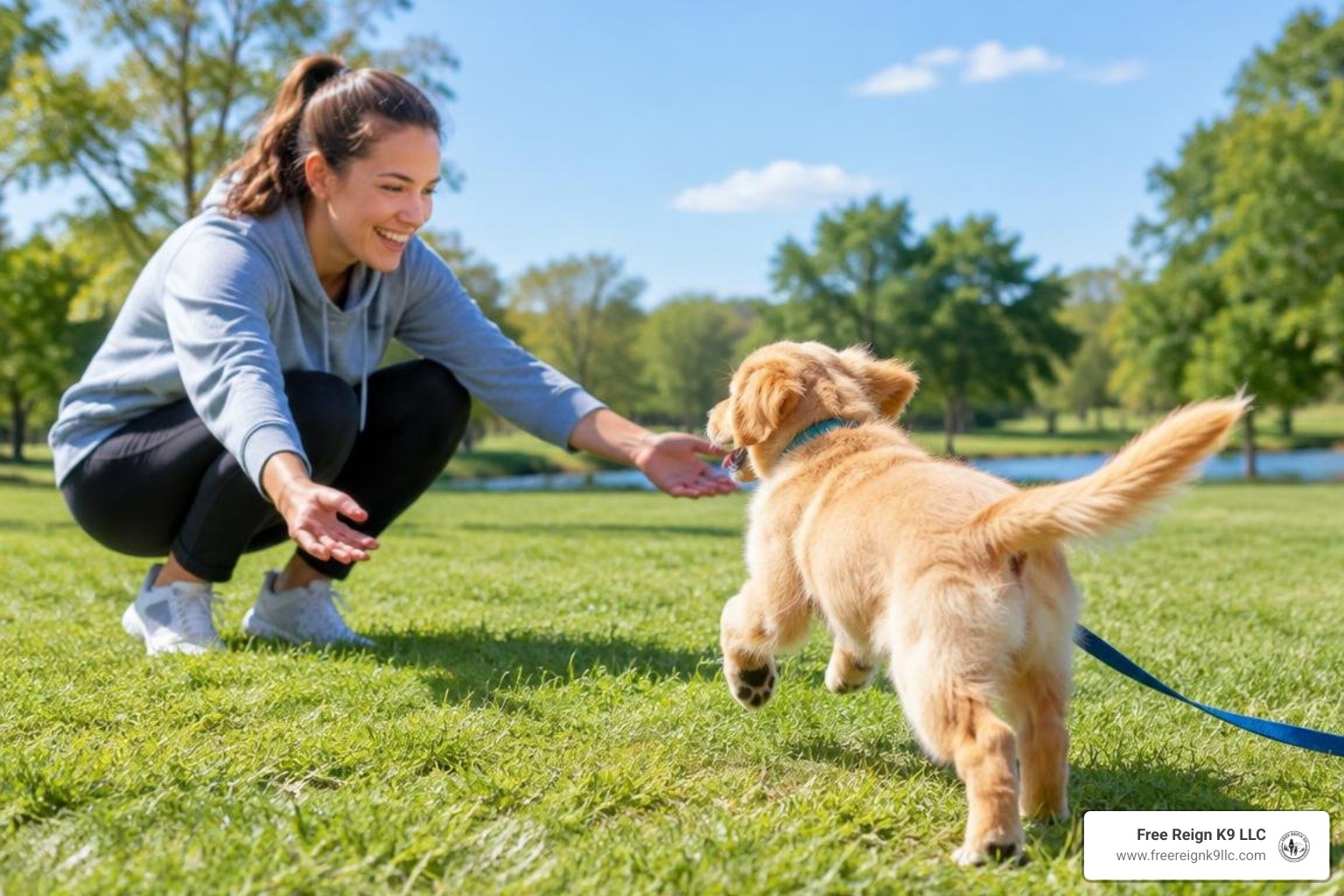
Hold a small, good-smelling treat directly in front of your puppy's nose. Slowly lift the treat upward and slightly backward over their head. As their nose follows the food, their bottom lowers toward the floor. The moment their bottom touches the ground, say "Yes!" and give them the treat. Add the word "Sit" once your puppy consistently follows the treat into position.
2. Down
Practice "Down" while your puppy is standing to help them learn how to move into position. Place a treat at your puppy's nose, then lower your hand straight down between their front paws and move it slightly outward along the floor. As their elbows touch the floor, say "Yes!" and give them the treat.
3. Come (Recall)
Teaching your puppy to come when called is an important safety skill. Begin indoors over short distances:
- Call your puppy's name followed by an upbeat "Come!"
- Back away a few steps to encourage your puppy to follow you.
- When they reach you, gently take hold of their collar, mark "Yes!", and offer a high-value reward, such as a favorite treat.
- Avoid calling your puppy to you for a correction, medication, or to end fun outdoor time. You want coming to you to stay rewarding.
4. Loose-Leash Introduction
Introduce the leash indoors where distractions are minimal. We do not recommend walking dogs with body harnesses. We do not use anti-pull leashes. Our best overall leash recommendation is a standard 6-foot, 1/2-inch braided leash made from quality leather. Reward your puppy simply for walking alongside your hip with the leash hanging slack in a "J" shape. If the puppy surges forward and tightens the leash, halt immediately. Become a stationary tree until they turn back or ease tension, then mark and step forward together again.
Advanced Impulse Control: Teaching Stay and Leave It
Impulse control helps your puppy pause and respond to you, even when they feel excited.
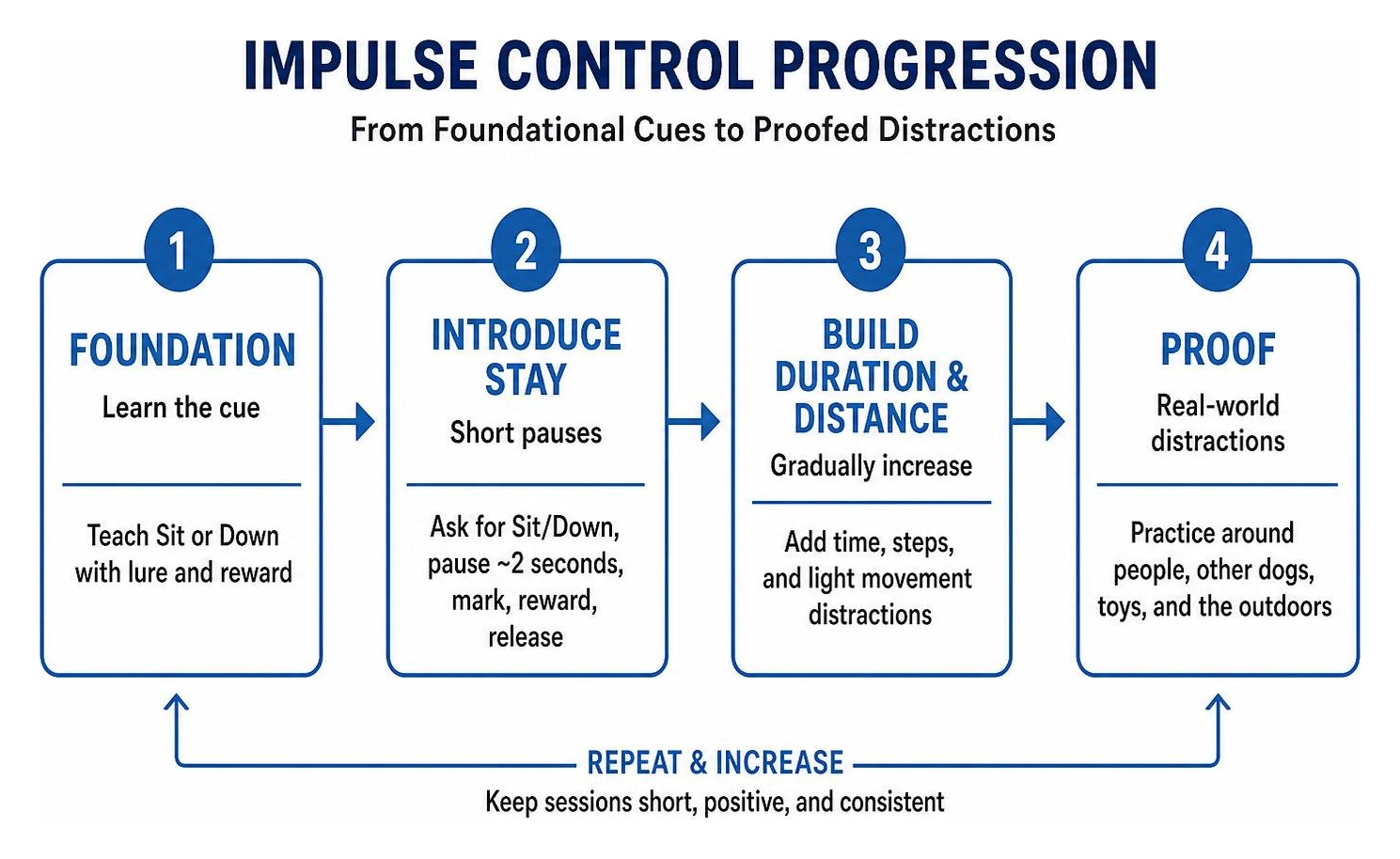
Rather than treating "Stay" as a desperate plea, build an implied stay where a position (Sit or Down) remains active until you offer a clear release cue (such as "Free" or "Break").
- Ask for a "Sit."
- Pause for 2 seconds without moving your body.
- Mark "Yes!", reward while they remain seated, and release with "Free!"
- Progressively add duration (seconds), then distance (steps back), and finally real-world distractions. Work on only one variable at a time to prevent failure.
"Leave It" teaches your puppy that ignoring a tempting item yields something even better:
- Hold a piece of plain kibble inside a closed fist.
- Allow your puppy to sniff, lick, or paw at your hand.
- The instant they pull their nose back or look away, mark "Yes!" and feed a higher-value treat (such as roast chicken) from your opposite hand.
- Your puppy quickly realizes that backing away from forbidden items produces superior rewards. Never feed the specific item you told them to leave.
Professional Board-and-Train Support
While many foundational manners can be introduced at home, busy work routines, family obligations, and bustling urban environments often create practical hurdles for owners. Deciding how to structure your puppy's education depends on your available time, consistency, and training goals.
| Training Feature | Home & Group Training | Professional Board-and-Train Programs |
|---|---|---|
| Primary Environment | Living room, backyard, local parks | Controlled facility, varied distraction zones |
| Daily Training Time | Owner-managed (15–30 mins spread out) | Dedicated daily sessions with professional trainers |
| Practice Around Distractions | Gradual, dependent on local conditions | Planned practice in different settings, with distractions added gradually |
| Learning Pace | Moderate (depends on the owner's timing and handling skills) | High (handled by experienced professionals daily) |
| Best Suited For | Flexible schedules, basic introductory cues | Busy households, dogs with a strong drive to work or play, reliable manners |
Structuring Home Practice and Professional Board-and-Train Support
Practicing at home gives you one-on-one time to bond with your puppy. At home or in a group class, you may need extra planning to gradually help your puppy respond reliably around busy city distractions.
When you want an immersive foundation managed by experienced professionals, exploring our comprehensive Programs & Services ensures your dog develops rock-solid habits.
Our specialized Dog Obedience Training Camps give puppies and adolescent dogs focused practice in balanced communication, crate manners, polite leash walking, and coming when called under real-world conditions. Our balanced approach pairs owner education with safe, proper use of training tools chosen for each dog and situation. We use tools such as prong collars and electronic training collars (e-collars) to teach dogs through feedback. If you prefer one-on-one instruction, our Dog Private Individual Training Lessons offer coaching tailored to you and your dog right in your neighborhood.
Selecting Professional Puppy Obedience Training Support
When choosing an instructor, reading resources like the American Kennel Club's guide on Basic Obedience Training For Puppies: Where to Start highlights the value of structured education.
Look for experienced professionals who communicate openly, show clear handling skills, and explain how their methods work and why they use them. Observe a class or consultation beforehand: dogs should look engaged, owners should receive helpful feedback, and the environment should feel safe and organized.
Dog trainers teach useful everyday behaviors, help owners improve their timing and handling skills, and work through common adolescent challenges. A board-certified veterinary behaviorist is a veterinarian who specializes in behavior, checks for medical causes, and can prescribe medication when needed for serious fear, anxiety, or aggression.
Troubleshooting Behavior Problems and Adolescent Regressions
Puppy development is rarely a straight line. Just when you feel your puppy has mastered their foundational skills, new behavioral hurdles and boundary-testing phases emerge.
Correcting Jumping, Inappropriate Chewing, and Barking
Common nuisance behaviors can be managed through consistent rules and environmental control:
- Jumping on Guests: Dogs jump to greet people face-to-face. Keep greetings consistent with a "four-on-the-floor" rule. Ask visitors to ignore your puppy (no eye contact, talking, or petting) until all four paws are on the ground. Teach your puppy to sit at the doorway instead, and reward them for staying seated.
- Inappropriate Chewing: If your puppy chews chair legs, baseboards, or shoes, consider whether they are getting enough activity and things to keep their mind busy. Puppies naturally want to chew, so give them suitable things to chew on. Keep off-limits household items out of reach and redirect them to dense rubber chew toys or natural antlers when they start chewing furniture.
- Demand and Alert Barking: If your puppy barks at you for food, toys, or attention, stop moving and look away. Giving in teaches your puppy that barking gets them what they want. For barking at things outside the window, use window film or adjust blinds to block the view, and reward your puppy for settling calmly on a designated mat.
Navigating Teenage Regressions and Fear Periods
Between 5 and 12 months of age, your puppy may enter adolescence, with changes in hormones and brain development. You may notice that they respond less reliably when called or struggle with household rules. Some puppies also become more wary of familiar objects, such as a fire hydrant or bicycle.
Adolescence is a normal developmental milestone, not a sign that your training has failed.
To help your puppy through this phase:
- Make the task easier whenever your dog struggles with distractions.
- Keep sessions short, positive, and rewarding.
- Maintain consistent household boundaries, even when your puppy needs extra practice with familiar rules.
- Use a long training line during outdoor recall practice to keep your dog safely connected to you.
Frequently Asked Questions
For more detailed answers regarding training styles and service structures, visit our comprehensive page addressing Frequently Asked Questions Dog Training in Seattle.
What is the 3-3-3 rule for bringing home a new puppy?
The 3-3-3 rule serves as a general guideline for the phases a puppy passes through when settling into a new home:
- First 3 Days: The puppy feels overwhelmed, cautious, and unsure of their environment. They may sleep excessively or hide.
- First 3 Weeks: The puppy begins adjusting to the daily schedule, shows their true personality, and starts testing boundaries.
- First 3 Months: The puppy feels fully settled, builds trust with the household, and establishes secure attachment to their owners.
Can you start obedience training before a puppy is fully vaccinated?
Yes. You can start basic obedience, crate training, name recognition, and household manners on day one at home. For early socialization before the vaccination series is complete, ask your veterinarian about suitable precautions. Options to discuss include clean private spaces, puppy classes that require initial vaccine records, and carrying your puppy through public spaces without letting their paws touch high-traffic ground.
When should you hire a veterinary behaviorist over a dog trainer?
Consult a veterinary behaviorist for serious concerns such as aggression without an obvious trigger, separation anxiety that causes your dog to injure themselves, repeated behaviors they struggle to stop, or fear that disrupts everyday life. You do not need to wait for training to fail before seeking veterinary help. For basic obedience, everyday manners, adolescent challenges, and responding reliably to you outdoors, a professional dog trainer can help you build and practice those skills.
Take the Next Step With Your Puppy
Building a well-mannered companion requires patience, daily consistency, and clear communication. Balanced training establishes boundaries that grant your dog greater freedom, ensuring they grow into a calm, confident, and dependable partner for all of life's adventures.
If you are ready to give your puppy the structure and guidance they need to succeed in Seattle, Madison Park, Magnolia, or West Seattle, Contact Us for Dog Evaluation today. At Free Reign K9 LLC, we are dedicated to helping you unlock a lifetime of balanced obedience, trust, and off-leash adventure with your dog.