
Practical Help for Reactive Dogs Starts With Safety and Space

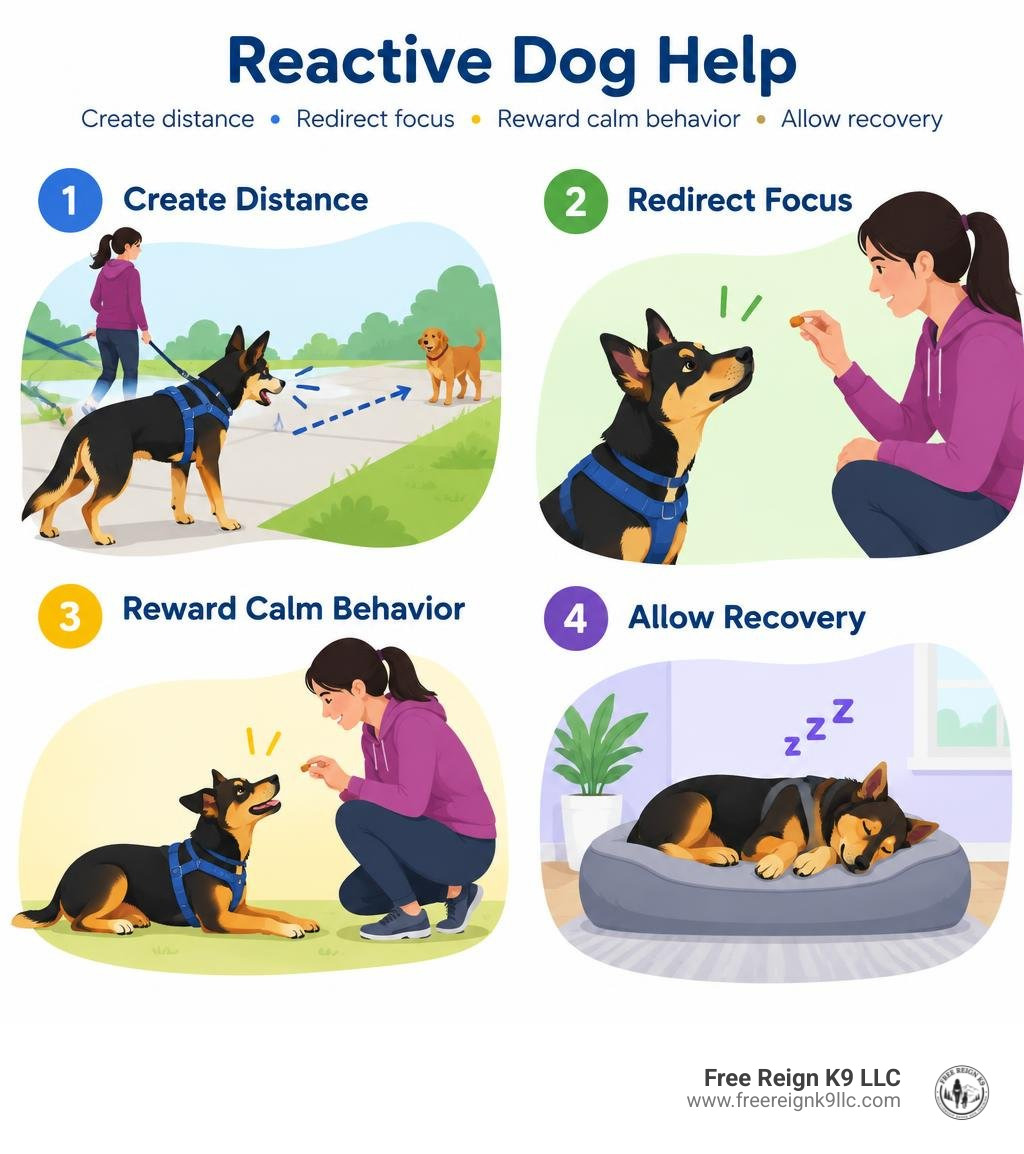
The most effective help for reactive dogs starts with creating distance from triggers, preventing repeated blowups, and rewarding calm choices. On walks, notice a trigger early, calmly turn away or cross the street, keep the leash secure without pulling tight, and use high-value treats to help your dog focus on you.
A reactive dog may bark, growl, lunge, freeze, pull, or stare when they feel scared, frustrated, excited, or overwhelmed. That does not automatically mean they are aggressive. It means their stress level has risen past the point where they can cope well.
Reactivity improves when you work below that emotional limit. Identify what sets your dog off, choose quieter routes and times, give them enough space, and use structured training such as counter-conditioning and "Look at That" exercises. After a hard incident, plan for recovery too: stress can linger for 48 to 72 hours, which can make the next outing harder.
I am Kim Blanton, a dog trainer with Free Reign K9 LLC in Tacoma, Washington, where I help owners build clearer communication and more balanced daily routines with their dogs. In this guide, I will walk you through practical, humane help for reactive dogs, from safer walks to lasting behavior change.
Understanding Canine Reactivity vs. Aggression
When your dog reacts strongly at the end of a leash (barking, lunging, spinning, or growling), it is easy for onlookers to label them as "mean" or "aggressive." But a big reaction does not, by itself, tell you whether a dog will bite.
Reactivity means a dog has a bigger-than-expected emotional response to something around them, such as another dog or a passing cyclist. Your dog may feel overwhelmed by fear, uncertainty, or frustration. An aggressive-looking display may be their way of asking for space, essentially shouting, "Stay away from me!" Aggressive behavior can include threatening or biting, and it can overlap with reactivity. Body language alone does not reliably tell you a dog's intent.
| Feature | Reactive Dog | Truly Aggressive Dog |
|---|---|---|
| What May Be Behind It | Fear, anxiety, frustration when a leash or barrier prevents access, or overexcitement | Protecting territory or valued items, an urge to chase and catch prey, or intent to cause harm |
| Underlying Goal | Increase distance from the trigger; make it go away | Close distance to engage, intimidate, or harm the target |
| Behavior Off-Leash | Often significantly calmer or avoids triggers entirely | May actively pursue conflict or attack targets |
| Body Language | Constantly scanning, pacing, lunging, whining, or suddenly becoming still | Stiff posture, weight shifted forward, low growls, or focusing directly on a target |
| Response to Distance | Calms down rapidly once distance is achieved | Remains fixated or attempts to pursue the target |
A common cultural assumption is that every dog should instantly love all people and strange dogs. But just like humans, dogs have individual social thresholds. When we force them into tight spaces on a six-foot leash, we eliminate their natural fight-or-flight choices. Because flight is impossible, they resort to a dramatic display to keep the world at bay. Veterinary research highlights this distinction; for instance, clinical insights on managing reactive behavior show that reactivity is predominantly rooted in fear rather than a spontaneous desire to dominate or attack.
Root Causes and Recovery After Stress
Reactivity rarely has just one cause. Your dog's inherited traits, past experiences, and physical health can all play a part.
- Socialization Gaps: Missing opportunities to get comfortable with new experiences during early puppyhood (weeks 3 through 14) can leave adult dogs unsure about unfamiliar sights, sounds, and greetings.
- Negative Experiences: A scary event, such as being attacked by an off-leash dog, can leave your dog more sensitive to similar situations afterward.
- Barrier Frustration: Dogs with lots of energy or a strong desire to greet others may become frustrated when a leash prevents them from approaching. That frustration can show up as barking and lunging.
- Physical Discomfort: Pain in bones or joints, digestive discomfort, or dental problems can lower your dog's tolerance for stress, making small disruptions harder to handle.
An intense reaction can involve stress hormones such as adrenaline and cortisol. Your dog may need time to settle afterward, but recovery varies. Rather than treating 48 to 72 hours as a fixed rule, watch how your dog is coping and give them quieter days when needed.
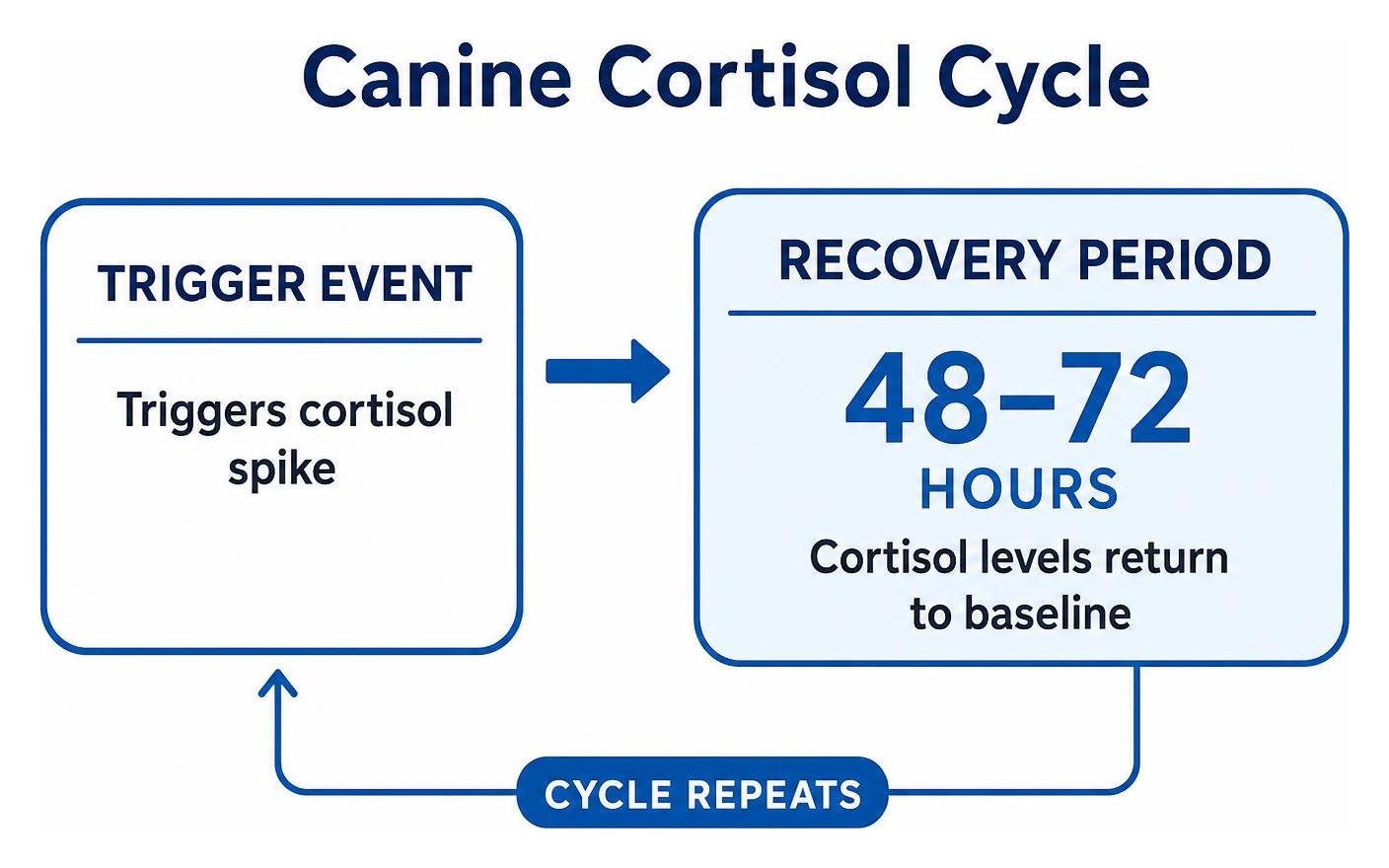
During this recovery period, stressful events can pile up before your dog has had time to settle. This is called trigger stacking. For example, a trash truck on Monday morning might leave your dog unsettled, making a passing cyclist harder to handle that afternoon. By Tuesday, even seeing a neighbor step outside might prompt a strong reaction. Your dog is not acting out of spite; they may need more time and space to recover.
Identifying Early Warning Signs and Thresholds
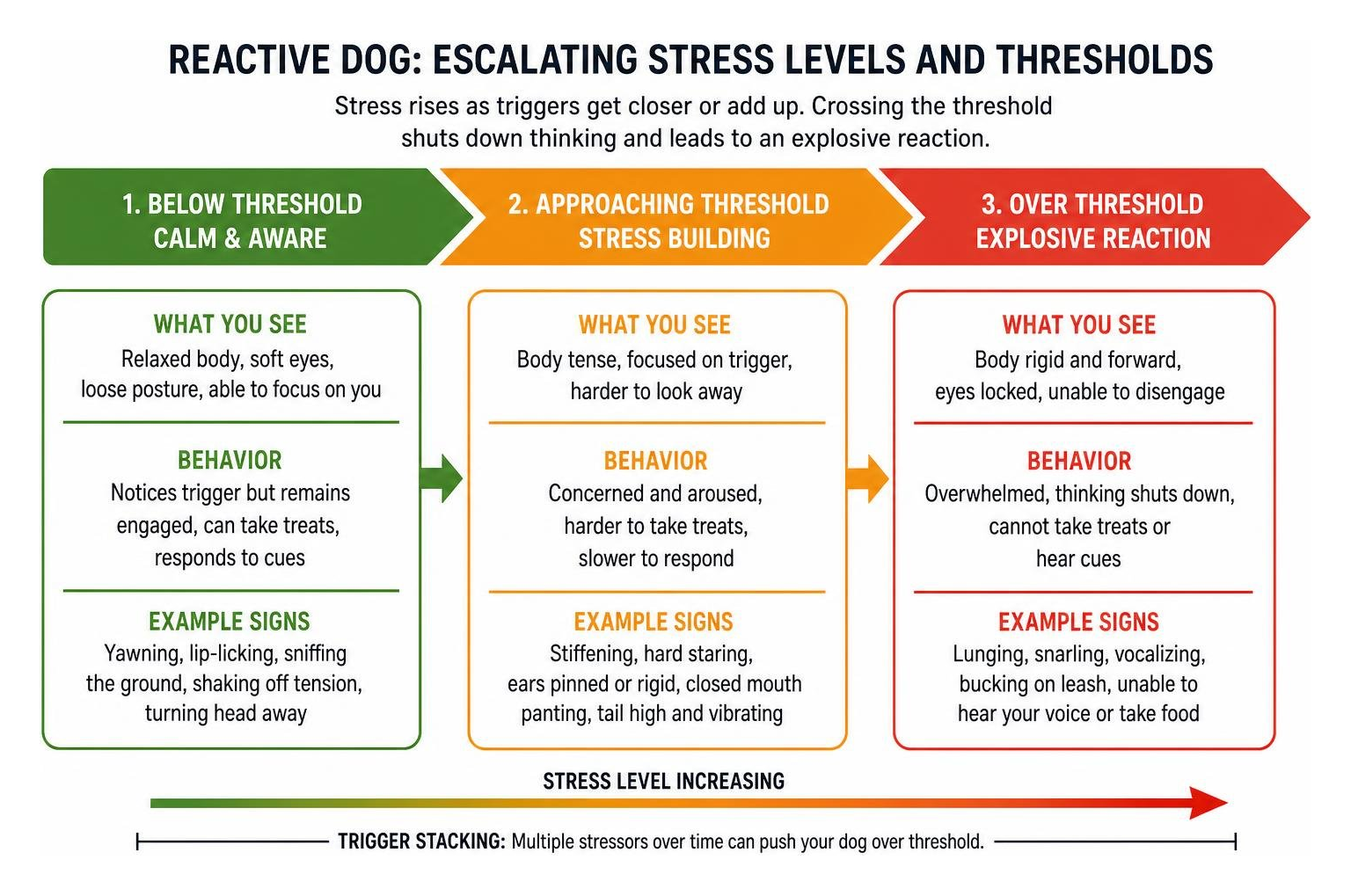
To help your dog before they bark or lunge, watch for their emotional threshold, the point where a situation becomes too much to handle. Below that point, your dog can notice a trigger while still responding to you and taking treats. When the situation becomes overwhelming, they may struggle to respond to familiar cues. Give them more space rather than asking them to push through.
Dogs offer numerous subtle physical signals long before they bark or lunge. Catching these early warning signs allows you to intervene before your dog boils over:
- Subtle Signs: Yawning, lip-licking, suddenly sniffing the ground as a way to cope with tension (sometimes called displacement behavior), shaking off, or turning their head away.
- Signs Your Dog May Need More Space: A stiff body, a fixed stare at the trigger, ears held rigidly back or upright, a suddenly closed mouth or rapid panting, or a high, tense tail.
- Strong Reactions: Lunging, snarling, high-pitched vocalizing, bucking on the leash, or being unable to respond to your voice or take high-value food.
Read these signs together and in context, rather than treating any one signal as a precise measure of your dog's stress.
Note how much space your dog needs before reacting, whether that is 50 feet, 30 feet, or 10 feet. This gives you a starting point for training.
Proven Training Strategies and Help for Reactive Dogs
Helping your reactive dog involves two approaches that work together: desensitization (helping your dog get used to a trigger through gradual exposure at a level they can handle) and counter-conditioning (pairing the trigger with rewards to help your dog feel more comfortable).
At Free Reign K9, we emphasize clarity, balance, and positive communication. Our balanced training approach emphasizes education and the safe, proper use of training tools chosen for each dog and situation. Depending on the dog and situation, we use tools such as prong collars and e-collars (electronic training collars) to teach through feedback, with guidance on safe, proper use. When teaching a dog that triggers are not threatening, we pair the sight of the trigger with high-value rewards (such as freeze-dried liver, string cheese, or real meats). Over repeated repetitions, the dog realizes: "Seeing another dog doesn't mean I am in danger; it means something amazing happens with my handler."
Step-by-Step 'Look at That' (LAT) Method
Developed by trainer Leslie McDevitt, "Look at That" (LAT) is a training game for dogs who react on leash. You reward your dog for noticing a trigger at a comfortable distance, helping them learn to turn back to you for a reward.
- Establish a Marker: Starting indoors, teach your dog that a marker word (like "Yes!") or a clicker sound means a treat is coming. Mark and treat 20–30 times, watching for your dog to turn toward you when they hear the sound.
- Find a Comfortable Starting Distance: Choose a quiet setting, such as a park bench 60 feet from a walking path. Adjust that distance so your dog can notice a trigger while still responding to you.
- Mark the Glance: When your dog spots a person or dog at that comfortable distance, say "Yes!" before they stiffen or bark.
- Deliver the Reward: Offer a high-value treat at your hip or in front of your dog's nose, encouraging them to turn away from the trigger.
- Gradually Reduce Distance: As your dog confidently turns back to you on their own, you might reduce the distance by 5 to 10 feet over several sessions, using smaller changes if needed. If your dog freezes or ignores the marker, you may be too close. Step back and give them more space.
Structured Behavior Modification and Focus Games
In addition to LAT, establishing predictable training patterns reduces anxiety by giving your dog clear tasks to focus on when the world feels unpredictable.
- The Emergency "Find It" Game: Toss a handful of small, smelly treats into the grass right in front of your dog while saying "Find it!" Sniffing for treats encourages your dog to lower their head and shift attention away from the approaching trigger.
- The 1-2-3 Walking Pattern: Count aloud rhythmically: "One, two, three!" On "three," deliver a treat beside your leg. Practice in your living room, then your driveway. On walks, this predictable rhythm can help your dog focus on you before they fixate on a distraction.
- Structured Heel & Position Changes: Practicing positions such as Sit, Down, or Middle (between your legs) gives your dog familiar tasks to focus on. Our structured dog behavior modification training helps you build clear communication so your dog can look to you for direction.
Real-World Management, Gear, and Handling Techniques
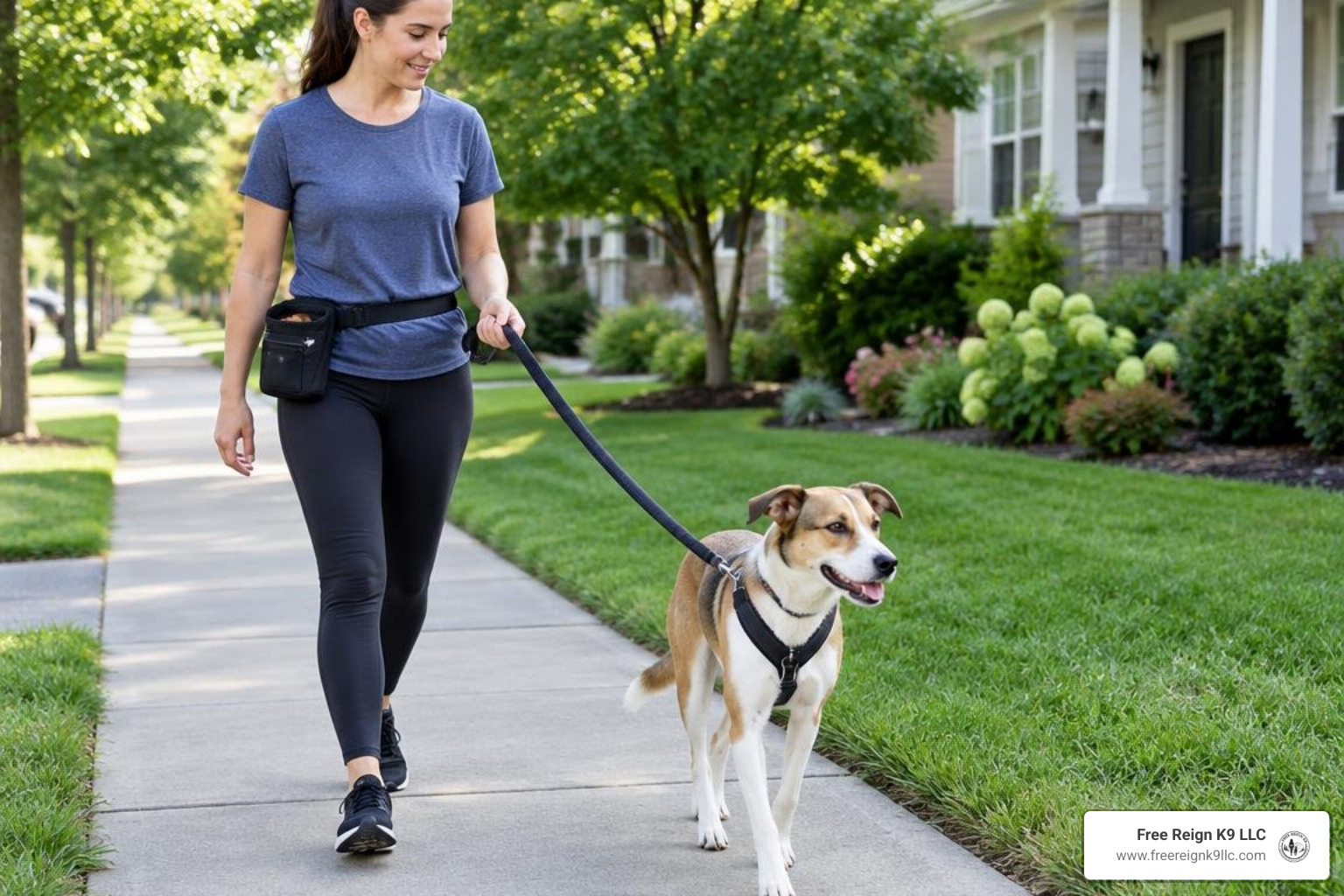
The harness shown is not a Free Reign K9 recommendation. We do not recommend walking dogs with body harnesses; ask your trainer about tools suited to your dog and situation.
Training takes time, but management keeps everyone safe today. Good management prevents your dog from practicing the unwanted behavior, which accelerates long-term training success.
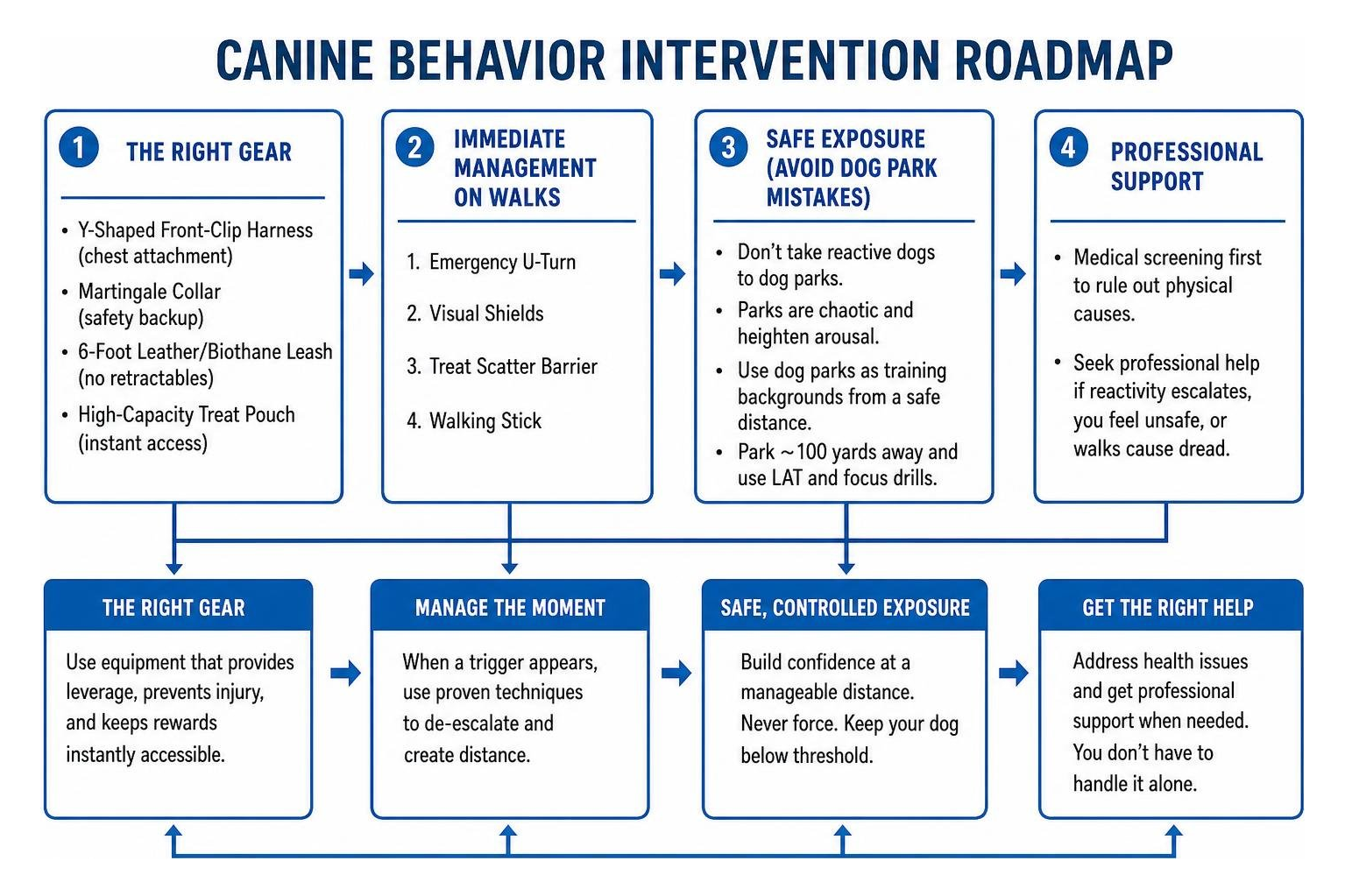
The right gear can help you handle your dog more safely:
- Individual Tool Selection: Free Reign K9 LLC does not recommend walking dogs with body harnesses. Ask your trainer about safely fitted tools suited to your dog and situation.
- Martingale Collar (Safety Backup): For dogs that need an additional safety backup, ask your trainer whether a properly fitted Martingale collar is appropriate. Do not assume any collar is slip-proof or cannot put pressure on the neck.
- Standard 6-Foot Braided Leather Leash: Free Reign K9 recommends a standard 6-foot, 1/2-inch leash made from quality braided leather as its best overall leash. We do not use anti-pull leashes. Avoid retractable leashes, which can make it harder to manage distance and maintain consistent control during a sudden reaction. A standard 6-foot leash lets you feel your dog's movements and handle the leash consistently.
- High-Capacity Treat Pouch: Keep high-value rewards within easy reach on your hip. Having treats ready helps you reward your dog at the right moment.
Immediate Management: Practical Help for Reactive Dogs on Walks
When you are out on a walk in neighborhoods like Magnolia or West Seattle and an unexpected trigger turns a blind corner, use these immediate handling techniques:
- The Emergency U-Turn: Do not pull straight back, which activates your dog’s natural opposition reflex (the urge to pull harder in the opposite direction). Instead, say a cheerful cue like "Let's go!", step across your dog’s path to gently block their line of sight, and lead them smoothly in the opposite direction.
- Visual Shields: Use parked cars, hedges, retaining walls, or utility boxes to break the line of sight. Stepping behind an SUV for ten seconds while a neighbor passes is smart management, not cheating.
- The Treat Scatter Barrier: If an approaching dog is getting too close, drop a large handful of treats into the grass to occupy your dog, stepping between your dog and the distraction to act as a physical and visual buffer.
- Carrying a Walking Stick: A lightweight walking stick or trekking pole serves two purposes: it creates a clear physical boundary between you and approaching dogs, and it gives you added balance and confidence on slippery or uneven terrain.
Safe Exposure and Avoiding Common Dog Park Mistakes
One of the most common and damaging mistakes owners make is taking a reactive dog to a dog park in hopes that they will "just get over it" or "work it out."
Dog parks can be busy, unpredictable, and overwhelming. Putting a fearful or frustrated dog into an enclosed space with excited dogs can lead to fights and reinforce defensive behavior. Do not use an off-leash park to force your dog to get comfortable with other dogs.
Instead, use dog parks strictly as training backgrounds from a safe distance. Positioning yourself 100 yards away from a fenced dog park creates an ideal, controlled setup. Your dog can observe other dogs running and playing while remaining well below their emotional threshold, allowing you to run LAT and focus drills in a structured setting.
When to Bring in Professional Support
Managing reactivity on your own can feel isolating and overwhelming. Knowing when to bring in professional assistance ensures safety and prevents behavioral issues from escalating.
Medical Screenings First
Before assuming your dog's behavior is only about emotions or training, schedule a thorough veterinary exam. Ask your veterinarian whether pain or illness could be playing a part. Joint problems, including hip dysplasia (a hip joint that develops abnormally) and osteoarthritis (joint wear that causes pain and inflammation), as well as dental problems or ear infections, may affect your dog's comfort. If physical discomfort is contributing to the behavior, your dog needs care for that alongside training.
Finding Professional Help for Reactive Dogs
If your dog’s reactivity is escalating, if you feel unsafe holding the leash, or if walks have become a source of dread, seek professional help. If you have questions about what balanced training looks like in practice, read through our frequently asked questions about dog training in Seattle to understand how structured instruction transforms daily handling.
When looking for the right program, prioritize trainers who understand how much space your dog needs, what motivates their behavior, and how to help you give clear cues. If you are ready for support with stressful daily walks, you can contact us for a comprehensive dog evaluation. Our team at Free Reign K9 LLC designs customized behavior plans across Seattle, Madison Park, Magnolia, and West Seattle to help you and your dog work toward calmer outings together.
Navigating Handler Stress and Burnout
Living with a reactive dog takes a real emotional toll. Owners often experience hypervigilance, scanning every street corner, dreading walk times, and feeling a deep sense of embarrassment or guilt when their dog has an outburst.
It is important to remember:
- Your dog’s reactivity is not a reflection of your worth as an owner. It is an emotional hurdle that can be managed with structured tools.
- Tight leashes transfer stress. When you tense up, grip the leash tightly, and hold your breath, your dog feels that tension through the line and assumes a threat is present. Focus on keeping your shoulders relaxed and your breathing steady.
- Give yourself permission to skip walks. If your dog had a severe reaction yesterday, do not force a high-stress walk today. Provide mental enrichment at home with puzzle toys, scent games, and backyard obedience drills to let their cortisol levels drop.
Frequently Asked Questions About Reactive Dogs
Can a reactive dog ever be fully rehabilitated?
Your dog can make progress, but that does not have to mean becoming a social butterfly. The goal is to help them handle distractions more comfortably and respond to you more reliably, even if they never enjoy greeting unfamiliar dogs. Look for progress in how calmly your dog passes distractions, how quickly they settle after stress, and how relaxed walks feel for both of you.
How should I handle an unfamiliar off-leash dog running toward us?
Stay calm and step directly in front of your dog to block their view. Use a loud, deep, assertive voice to command: "NO! GO HOME!" or "STAY!" while holding out an open palm. If the dog continues approaching, toss a large handful of treats directly into their face or onto the ground ahead of them; most off-leash dogs will stop to eat the food, giving you time to move away safely.
Why did my dog develop reactivity suddenly in adulthood?
As dogs mature, often between 18 and 36 months, some become less comfortable with certain dogs or people, more protective of their space, or more sensitive to things around them. A scary encounter or hidden physical pain can also contribute. If your dog's behavior changes suddenly, arrange a veterinary exam rather than assuming it is just part of growing up.
Moving Toward Calmer Walks
Reactivity does not have to define your relationship with your dog. By noticing when your dog needs more space, allowing recovery time after stressful outings, using training games like Look at That (LAT), and choosing safety gear with professional guidance, you can work toward calmer daily walks and more enjoyable time outdoors together.
Lasting transformation requires patience, consistency, and a balanced approach tailored to your dog's specific needs. At Free Reign K9 LLC, we believe in unlocking true freedom for dogs and their handlers through balanced training, clear structure, and dedicated support.
If you are ready to take the next step toward a calm, confident companion, explore our comprehensive dog training services and programs to start building the balanced life you and your dog deserve.