
Is Boarding and Training for Puppies Right for Your Dog?
Boarding and training for puppies can give your dog a strong start, but it is not a one-time fix. Before you enroll, ask how the puppy will be cared for, what skills will be taught, which tools may be used, and how you will learn to keep up the training at home. Puppies need practice with you for new skills to carry over after their stay.
At Free Reign K9 LLC, our balanced training philosophy pairs education with the safe, proper use of tools for each dog and situation. We use feedback tools such as prong collars and e-collars when appropriate. For walks, we recommend a standard 6-foot, 1/2-inch braided leash made from quality leather as our best overall choice. We do not condone walking dogs with body harnesses or use anti-pull leashes.
I’m Kim Blanton, a dog trainer at Free Reign K9 LLC, where I work with dogs and their owners through our board-and-train programs. I’ll help you understand what to look for in boarding and training for puppies, including the care, training, and owner practice that matter most.

What to Expect from Boarding and Training for Puppies
Bringing home a new puppy fills your life with joy, but it also brings boundless energy, nipping, sleepless nights, and frequent potty accidents. Enrolling your pup in an immersion environment allows professional handlers to lay down foundational habits quickly and efficiently. Through specialized Puppy Head Start Programs, trainers handle the early heavy lifting so you and your family can enjoy a confident, well-adjusted pet.
A quality puppy residency is an accelerated learning camp designed around developmental stages. Rather than a solitary hour-long weekly class where you try to digest complex handling mechanics while juggling a squirming puppy, immersion training surrounds your pup with professional guidance around the clock.
Accelerated Learning and Immersion Environment
Puppies learn at lightning speed when their routine is predictable. In our Dog Obedience Training Camps, young dogs benefit from round-the-clock consistency. Every bathroom trip, mealtime, and play session becomes an intentional learning opportunity.
Because professional trainers handle the daily rhythm, bad habits are interrupted before they become ingrained patterns. Handlers establish clear impulse control, calm crate manners, and dependable routines that build emotional stability during critical developmental windows.
Core Skills Addressed in Boarding and Training for Puppies

A comprehensive puppy camp targets the foundational behaviors that dictate whether your dog is a joy or a chore to live with. Core focus areas include:
- Housebreaking and Crate Conditioning: Setting strict biological routines so potty training becomes second nature and the crate represents a restful safe haven.
- Bite Inhibition and Play Manners: Teaching puppies how to interact gently with human skin and clothing without sharp puppy teeth making contact.
- Threshold Boundaries: Preventing door-dashing and teaching your dog to wait patiently at exterior doors, crates, and vehicle gates.
- Leash Manners: Building early engagement, focus, and clean walking habits without erratic pulling or sniffing off-track.
- Controlled Social Exposure: Providing safe, neutral exposures to unfamiliar sounds, sights, surfaces, and environments rather than chaotic free-for-all dog park scenarios.
Balanced Methods, Leash Mechanics, and Puppy Development Tools
At Free Reign K9 LLC, we practice a balanced training approach. That means we emphasize fair, clear communication above all else. We reward desired behaviors enthusiastically using food, play, and praise, while also establishing healthy boundaries so young dogs understand what is expected of them in real-world scenarios.
Safe Communication Tools and Proper Leash Selection
Clarity on the leash is essential for setting your puppy up for success. We believe in using the simplest, most effective gear available. We recommend a standard 6-foot braided leather leash as our best overall leash, specifically a 6-foot, 1/2-inch leash made from quality leather. Leather gives the handler a secure, comfortable grip without burning your hands, and the fixed 6-foot length keeps communication clear.
We do not condone walking dogs with body harnesses, and we do not use anti-pull leashes. Harnesses trigger an instinctive opposition reflex, encouraging dogs to lean forward and pull like sled dogs. Anti-pull harness contraptions often cause awkward gait restrictions and fail to teach actual leash communication.
Instead, we use tools such as prong collars and e-collars to teach dogs through feedback when appropriate for their age, temperament, and training stage. When properly fitted and introduced with gentle education, these tools provide subtle, humane tactile communication that cuts through heavy environmental distractions without frustration or physical wrestling.
Marker Training, Food Drive, and Clear Feedback
During the early stages of our Dog Behavior Modification Training and puppy programs, we tap into your dog's natural food drive. We utilize marker training (such as clear verbal markers like "Yes" or "Good") to pinpoint the precise second a puppy performs a desired action.
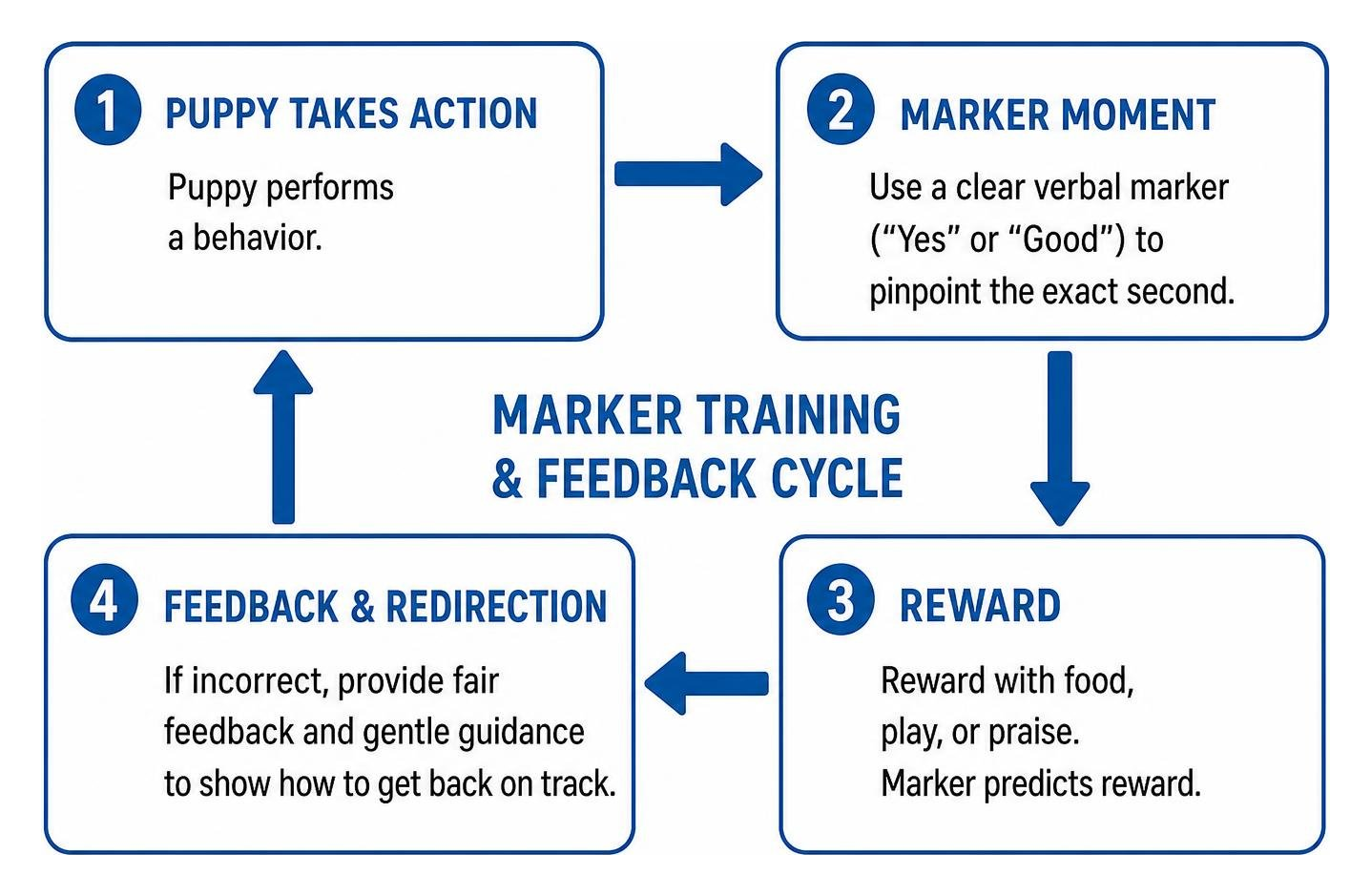
Once a puppy understands that marker words predict rewards, we weave in gentle tactile guidance to give complete clarity. If a puppy makes an incorrect choice, fair feedback shows them how to get back on track without creating confusion or fear.
The Owner’s Role in Generalization and Long-Term Success
A common misconception is that a puppy returns home from an immersion program fully programmed like a computer. In reality, dogs are highly contextual learners. A behavior mastered at our training property does not automatically transfer to your living room unless you reinforce it.
Our Board and Train programs are designed to build a stellar foundation, but your ongoing leadership turns that foundation into lifelong reliability.
Overcoming Environmental Gaps and Context-Specific Habits
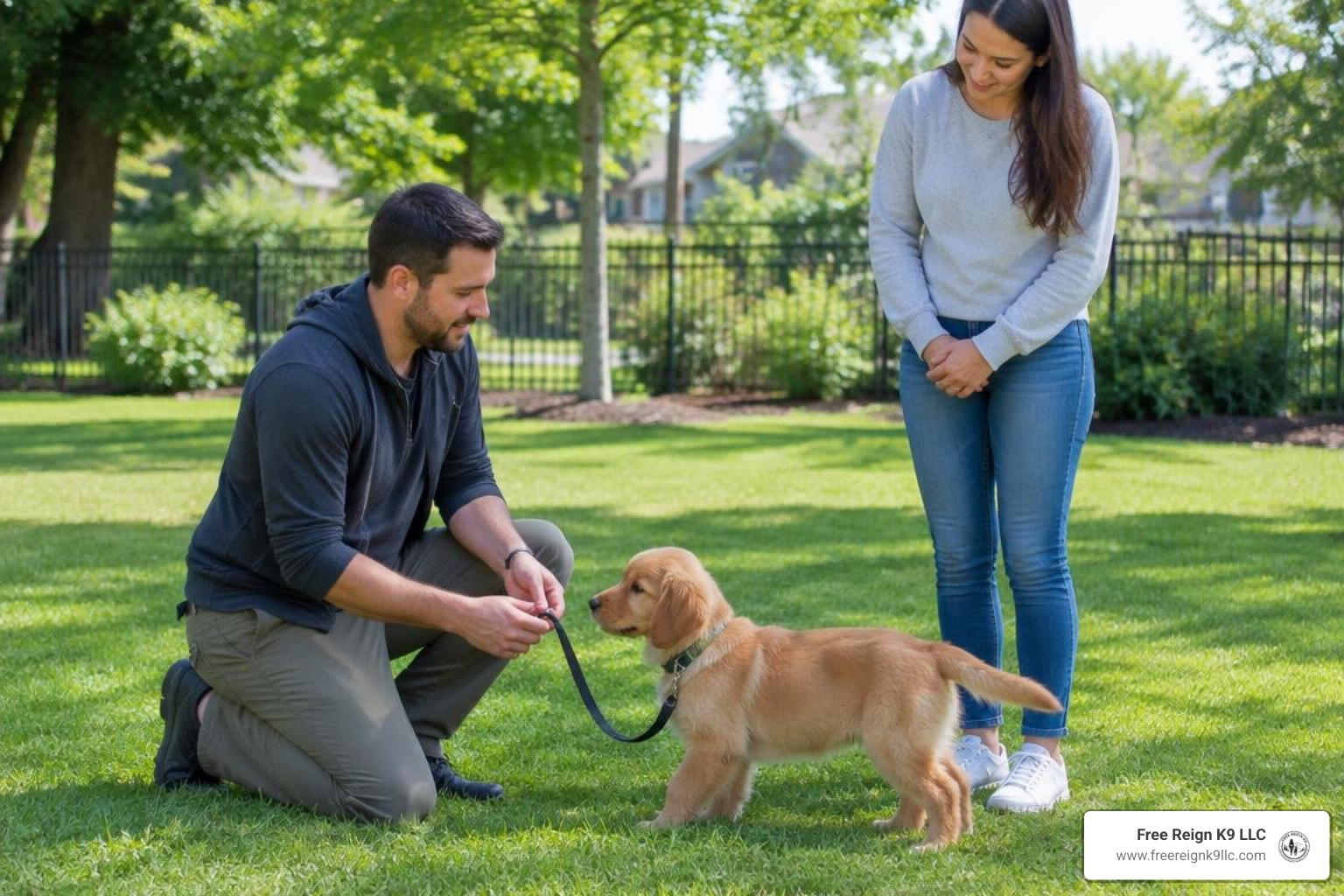
When your puppy returns home, they will quickly test whether your house operates under the same rules as camp. If a puppy was taught to sit calmly before exiting doors during camp, but you allow them to rush past you at home, the training will quickly unravel.
To bridge this gap, owners must use the exact same verbal cues, hand signals, and boundary expectations established during the program. Consistency from every family member ensures your pup realizes good manners apply everywhere, not just around professional trainers.
Hands-On Owner Hand-Offs and Structured Follow-Up Support
The hand-off session is one of the most critical parts of the entire training journey. When you pick up your puppy, we spend dedicated time coaching you through handling mechanics, leash pressure, marker timing, and daily household routines. We ensure you feel completely confident managing your puppy in real-world settings across Seattle, Tacoma, Mercer Island, Gig Harbor, and neighboring communities.
Continued practice at home with toys, praise, and regular rewards solidifies the bond between you and your dog, turning new habits into permanent lifestyle patterns.
Evaluating Facility Standards, Red Flags, and Training Alternatives
Choosing who cares for and trains your puppy is a major decision. Not all programs offer the same standard of care, supervision, or training methodology.
What to Look for in Safe, Professional Programs
When evaluating potential facilities, keep an eye out for these critical markers of quality:
- Clean, Secure Living Quarters: Kennels should be spotless, climate-controlled, well-ventilated, and safe from escape hazards.
- Transparent Training Philosophy: Trainers should openly discuss their methods, their use of tools, and their daily schedule.
- No Unrealistic Guarantees: Be cautious of any facility that promises guaranteed perfection. Every dog is an individual with unique genetic drives, learning curves, and temperaments.
- Hands-On Transfer Sessions: Look for programs that prioritize teaching you just as much as they prioritize teaching your dog.
Is Boarding and Training for Puppies Right for Your Lifestyle?
While immersion stays offer massive advantages for busy owners, they are not the only path forward. Depending on your schedule and handling goals, private coaching might be a better fit.
| Training Format | Best Suited For | Owner Time Commitment | Learning Pace |
|---|---|---|---|
| Puppy Board & Train | Busy owners, working professionals, families needing a fast behavioral foundation | Low daily time during camp; high consistency after pickup | Rapid, fully immersive daily learning |
| Private Lessons | Owners who want to learn handling step-by-step alongside their dog | Moderate to high weekly practice at home | Gradual, building week over week |
If you prefer to be the primary handler from day one, exploring our Dog Private Individual Training Lessons can be a fantastic way to develop your personal handling skills directly under a trainer's eye.
Frequently Asked Questions About Puppy Board and Train
If you are looking for local guidance, our Frequently Asked Questions Dog Training in Seattle resource covers many common owner inquiries. Here are answers to a few core questions we receive regularly.
What age is ideal to start a puppy immersion training camp?
Most puppies do wonderfully entering an immersion program between 16 and 24 weeks of age. By this point, they have completed their essential core vaccination series and have developed the physical and mental maturity needed to engage in structured daily learning routines. Starting early prevents bad habits from becoming lifelong behavioral issues.
How do you prevent a puppy from regressing after returning home?
The key to preventing regression is maintaining the daily structure established during camp. Follow the customized feeding, crate, and bathroom schedules provided by your trainer. Consistently enforce household rules, practice short 5-minute training sessions daily, and never reward pushy or demand-driven behaviors.
Why are body harnesses and anti-pull devices avoided during leash training?
Body harnesses encourage pulling by distributing pressure across the dog's chest and shoulders, tapping straight into their natural opposition reflex. Anti-pull harnesses often pinch or torque the dog awkwardly without teaching actual communication. A standard 6-foot, 1/2-inch leather leash paired with clear, humane feedback tools teaches the dog how to follow directional cues willingly and calmly.
Build a Reliable Foundation for Lifelong Outdoor Adventure
A well-trained puppy gives you the freedom to explore the Pacific Northwest with total confidence. Whether your dream is enjoying outdoor coffee in Magnolia, strolling through West Seattle parks, or embarking on mountain adventures around Gig Harbor and Browns Point, early training opens the door to a richer life together.
At Free Reign K9 LLC, we follow a balanced training philosophy that champions education alongside the safe, proper use of training tools tailored to each puppy's unique personality.
Ready to transform your puppy into a reliable, well-mannered companion? Contact Us for Dog Evaluation today or visit Free Reign K9 LLC to find the ideal training program for your four-legged family member.