
Taming the Temperament: Proven Strategies for Training Aggressive Dogs
Identifying the Root Causes and Triggers of Canine Aggression

The best way to train an aggressive dog starts with careful management of your dog's surroundings, gradual exposure at a comfortable distance, and pairing triggers with rewards, alongside education and the safe, proper use of training tools suited to the individual dog and situation. That means using barriers and safety equipment to prevent unsafe encounters, keeping enough distance for your dog to stay calm, and rewarding them when a trigger appears to help change how they feel about it. Avoid harsh responses that can suppress warning signs without addressing the cause. Aggression can be a way for your dog to create space from something they find threatening, uncomfortable, or overwhelming. Whether your dog guards a food bowl, snaps at strangers on the sidewalk, or lunges at other dogs, understanding what sets off the behavior helps you choose a safer training plan.
Common drivers behind aggression include:
- Fear and Anxiety: When your dog feels trapped or threatened, barking, snapping, and lunging may be ways to make something frightening move away.
- Resource Guarding: Also called possessive aggression, this happens when your dog protects something they value, such as food, toys, a resting spot, or a particular person.
- Territorial and Protective Instincts: These behaviors can emerge as dogs reach social maturity, when they develop adult social behavior, typically between one and three years of age.
- Frustration-Elicited Aggression: Often called barrier frustration, this can happen when a leash, fence, or window keeps your dog from interacting with or moving away from a trigger. Their frustration can build into an aggressive display.
- Redirected Aggression: When your dog is highly worked up by a trigger they cannot reach, they may bite a nearby object, person, or companion animal instead.

Understanding these root causes helps shift perspective. Labels like "dominant" or "bad dog" are unhelpful because they imply that aggression is an unchangeable personality flaw. In reality, aggression is a symptom of underlying emotional distress or physical discomfort.
Aggression vs. Reactivity: Recognizing Key Differences
You may hear "reactive" and "aggressive" used interchangeably, but understanding the difference can help you choose a suitable training plan for your dog.
Reactivity means your dog becomes highly worked up and reacts strongly to everyday sights, sounds, or situations. They might bark, bounce, whine, or pull hard on the leash because they are excited, frustrated, or anxious. Aggression involves threatening behavior or behavior that can cause physical harm, such as snapping or biting. The two can overlap, so barking or pulling alone does not tell you what your dog is feeling or how safely they might interact.
| What to Look For | Reactivity | Aggression |
|---|---|---|
| What May Be Driving It | Frustration, being highly worked up, excitement, mild fear | Intense fear, protecting territory, pain, a strong urge to defend themselves |
| Common Body Language and Behavior | Bouncing, high-pitched barking, pulling, scanning | Rigid body, hard stare, lip curl, deep guttural growl |
| Intent of the Behavior | Gaining access, expressing frustration, increasing space | Creating distance, stopping a perceived threat, protecting something they value |
| Behavior off-leash or free | Often greets (even if socially awkward or overwhelming) | Avoids, charges, snaps, or attempts to bite the target |
| Bite Risk Level | Low to moderate (usually accidental or redirected) | High (deliberate contact intended to defend or deter) |
A highly worked-up, reactive dog may also show aggression. Repeated stressful encounters, especially when warning signs are ignored, can lead to escalation. Give your dog space and respond to early signs of discomfort rather than waiting for snapping or biting.
Checking for Pain and Illness With Your Veterinarian
Before beginning a behavior training plan, arrange a thorough checkup with your veterinarian, especially if your dog's aggression is new or getting worse. Pain or illness can contribute to behavior changes. When your dog is uncomfortable, their ability to cope with stress can drop sharply, and you may notice irritability, sensitivity to touch, or uncharacteristic snapping.
Possible health-related causes of sudden or worsening aggression to discuss with your veterinarian include:
- Bone, Joint, and Back Pain: Conditions include osteoarthritis (joint disease), hip dysplasia (abnormal hip development), luxating patellas (kneecaps that slip out of place), and spinal disc disease.
- Dental Disease: Hidden tooth-root abscesses, fractured teeth, or inflamed gums can make eating or having the head touched painful.
- Hormone and Metabolism Problems: Ask your veterinarian about conditions such as hypothyroidism (low thyroid hormone levels) and Cushing’s disease (excess cortisol, a hormone involved in the stress response).
- Skin and Ear Problems: Chronic ear infections (otitis), severe allergies, and hot spots can cause discomfort.
- Brain, Vision, and Hearing Changes: Your veterinarian may check for vision or hearing loss that makes your dog startle more easily, brain tumors, and Canine Cognitive Dysfunction (dementia) in senior pets.
The guidance on signs of aggression in dogs and what to do is a useful starting point for understanding your dog's behavior. If you notice sudden changes, arrange a veterinary assessment before training begins.
Reading Warning Signals and Body Language
Before a bite, your dog may show subtle warnings that are easy to miss or have been suppressed through punishment. Not every dog shows the same signals or follows a predictable sequence. Learning to recognize early signs of stress helps you give your dog space and keep training safer.
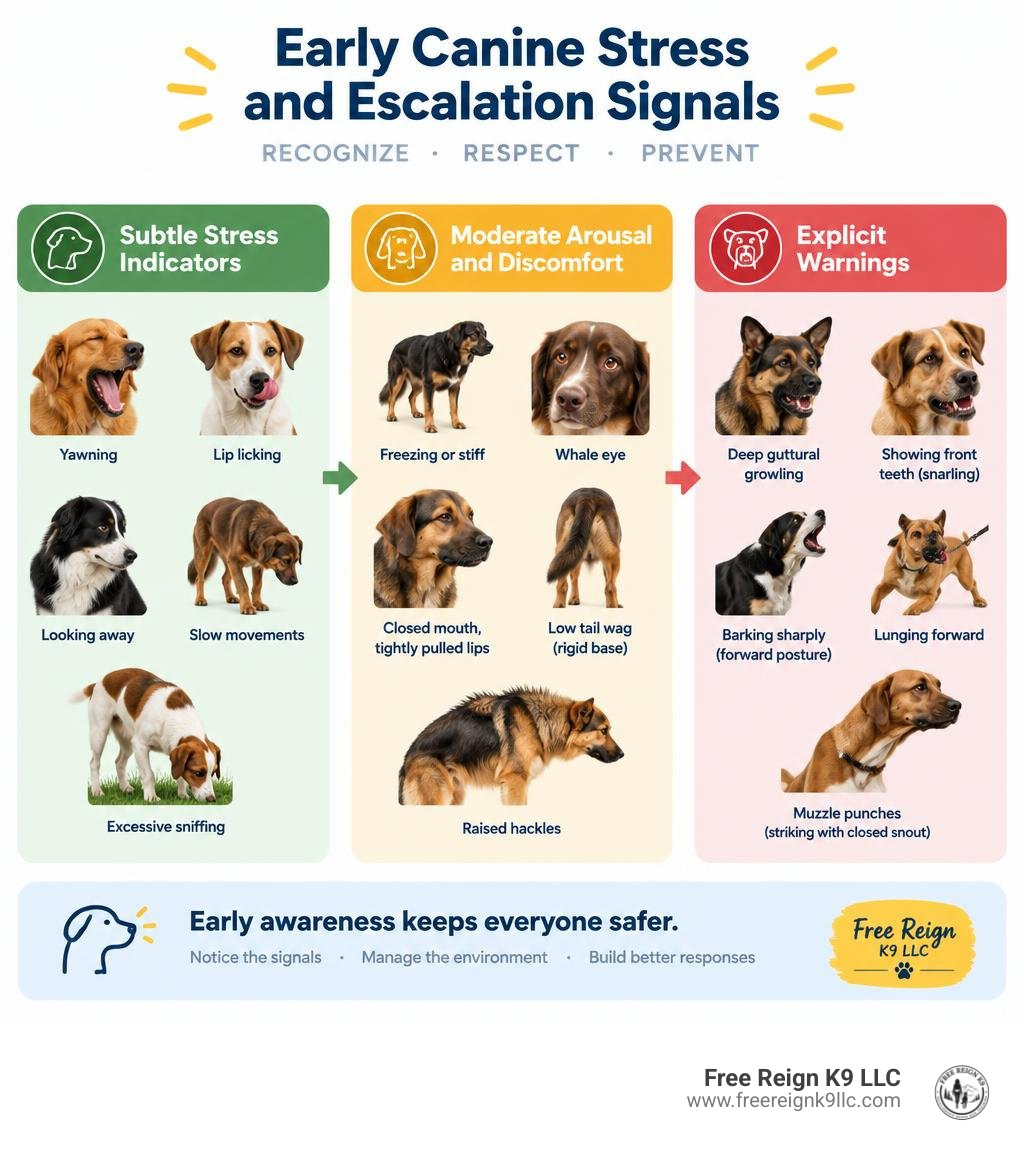
Watch for these signs of stress and signs that your dog is becoming more worked up:
- Subtle Stress Indicators: Yawning outside of resting times, sudden lip licking, looking away (averting gaze), slow or deliberate movements, and excessive sniffing of the ground.
- Becoming More Worked Up or Uncomfortable: Freezing or becoming stiff and still, hard "whale eye" (showing the whites of the eye), closed mouth with tightly pulled lips, low tail wag with a rigid base, and raised fur along the spine.
- Explicit Warnings: Deep guttural growling, showing front teeth (snarling), barking sharply with forward posture, lunging forward, and muzzle punches (striking the target with a closed snout).
- Physical Escalation: Air snapping (deliberately missing to give a final warning), quick skin-tearing nips, puncture bites, and clamping or shaking.
A dog can move from a silent freeze to a contact bite in milliseconds. Treating a growl as valuable feedback rather than a behavioral flaw keeps both you and your dog safe.
Immediate Safety Measures and Crisis Management
When living with an aggressive dog, your first responsibility is environmental management. Management means structuring your dog's surroundings so they cannot physically practice the aggressive behavior, rehearse unsafe habits, or pose a danger to family members, guests, and the public.
Essential Safety Equipment: Basket Muzzles, Barriers, and Leashes
Using proper safety tools removes the immediate risk of physical injury, which in turn lowers human stress and allows the dog to learn without panic.
- Baskerville or Wire Basket Muzzles: A properly fitted basket muzzle allows the dog to pant, drink water, take high-value treats, and breathe freely while completely preventing bite contact. Muzzles should never be used as a punishment; they are safety equipment introduced gradually with positive associations (peanut butter, squeeze cheese) until the dog willingly puts their nose inside.
- Physical Barriers and Baby Gates: Use tall, securely mounted baby gates, exercise pens, and closed doors to create physical separation in the home. This prevents door-dashing, eliminates territorial posturing at front windows, and keeps the dog safe when visitors arrive.
- Leashes and Handling Gear: Never rely on retractable or thin single-clip leashes for an aggressive dog. Free Reign K9 LLC recommends a standard 6-foot, 1/2-inch braided leash made from quality leather as its best overall leash, used with properly fitted handling equipment selected with professional guidance, not a body harness. For higher-risk outings, ask your trainer to select secure handling equipment for your dog; Free Reign K9 LLC does not recommend walking dogs with body harnesses and does not use anti-pull leashes.
What to Do After a Bite or Dangerous Near-Miss
If a bite or dangerous near-miss occurs, responding calmly and following clear steps can reduce distress and the risk of another incident.
- Prioritize Human Safety and First Aid: Put a secure barrier between your dog and the victim if you can do so safely. Avoid screaming, striking, wrestling with the dog, or grabbing their collar. Do not approach an agitated dog to force them into a room. Wash human bite wounds with mild soap and running water and seek prompt medical attention, especially for punctures, which can become infected.
- Give Your Dog Time to Settle: Stress can remain after an aggressive episode, and recovery time varies. Keep your dog in a quiet, low-stimulation space with water, comfortable bedding, and simple enrichment, such as a stuffed chew toy if safe for your dog. Avoid known triggers and ask your veterinarian or behavior professional when to resume training.
- Document the Incident's Details: While the event is fresh in your mind, write down the time, surroundings, distance from the trigger, visible warning signs, injuries, and what ended the incident. Record the bite severity for your professional to assess, using Dr. Ian Dunbar's Bite Assessment Scale where appropriate. This log can help your veterinary behaviorist plan the next steps.
The Best Way to Train an Aggressive Dog Step-by-Step
Helping your dog with aggression takes a clear plan based on how dogs learn. The goal is not just to stop barking or lunging, but to help your dog feel calmer and less threatened around what sets them off.
Finding a Distance Where Your Dog Can Stay Calm
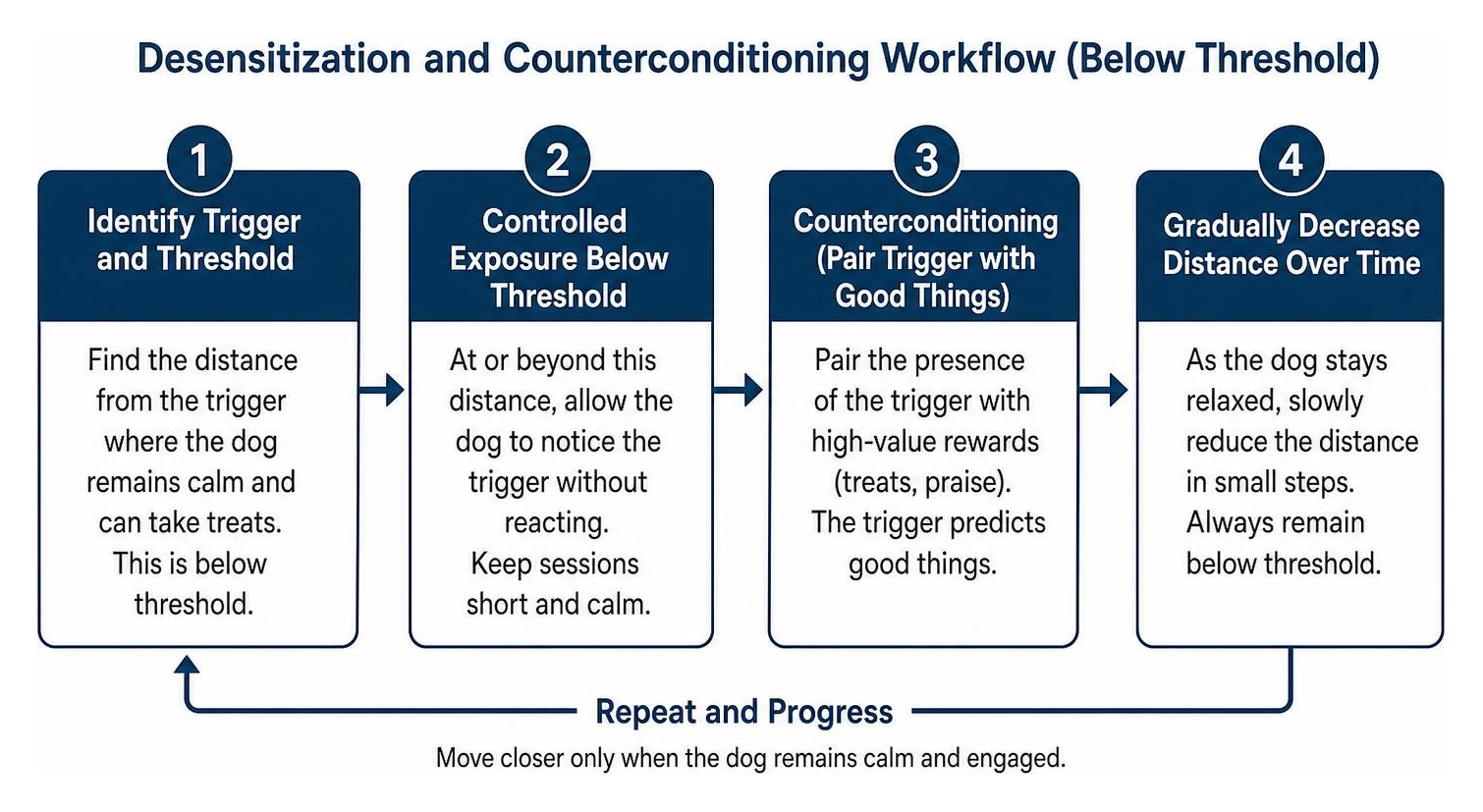
The foundation of behavior modification is working below threshold, where your dog can notice a trigger and still stay calm. Your dog's "threshold" is the point at which stress or excitement becomes too much for them to stay calm around that trigger. Distance from the trigger can affect when they reach that point.
If your dog is growling, barking, refusing treats, or pacing around a trigger, they may be over threshold. Stress can make it harder for your dog to focus and respond to familiar cues. Give them more space rather than pushing through the session. To find a comfortable starting distance:
- Identify the exact distance at which your dog notices the trigger but remains relaxed (loose body, soft eyes, willing to eat treats, able to look back at you).
- If your dog reacts at 30 feet, begin all training sessions at 50 feet.
- Always preserve an escape route. Move sideways or turn around if the trigger approaches too quickly, keeping enough distance for your dog to stay calm.
Implementing the Best Way to Train an Aggressive Dog Using Counterconditioning
Counterconditioning changes a dog's emotional response by pairing the sight or presence of a trigger with an exceptionally high-value reward. The trigger becomes the predictor of something fantastic.
- Set Up at a Safe Distance: Position your dog in an environment where triggers appear predictably at a sub-threshold distance.
- Pair the Trigger with High-Value Food: The moment the dog sees the trigger (stranger, dog, bicycle), begin delivering continuous, high-value treats (real chicken breast, freeze-dried liver, string cheese).
- Remove the Reward When the Trigger Disappears: As soon as the trigger leaves the dog's line of sight, immediately stop feeding treats and return to neutral interaction.
- Repeat and Condition: Through consistent repetition, the dog learns: Trigger appears = delicious food happens; trigger leaves = fun ends.
Over structured sessions, gradual exposure paired with rewards can help your dog feel better about the trigger. If your dog reacts to several triggers or you are unsure how to keep sessions safe, professional dog behavior modification training can help you plan the setup and timing for your individual dog.
Determining the Best Way to Train an Aggressive Dog with Past Trauma
Dogs that have experienced severe neglect, physical abuse, chronic isolation, or chaotic early development require patience and predictability. In studies evaluating dog-bite fatalities, dogs kept isolated from regular, positive human interactions were present in 76.2% of cases, highlighting how isolation and limited positive experiences with people can make it harder for dogs to cope.
When working with traumatized dogs:
- Use Training Tools Safely and Thoughtfully: Use training tools only with education, proper fit, clear timing, and the right level of guidance for your individual dog. Free Reign K9 LLC uses tools such as prong collars and e-collars to teach dogs through feedback. Tool selection and use should be guided by education, proper fit, and the individual dog and situation. The goal is to support safety, communication, and dependable behavior without escalating fear, confusion, or risk.
- Establish Predictable Routines: Traumatized dogs thrive on consistency. Maintain set schedules for feeding, exercise, training, and rest to lower overall environmental stress.
- Respect Agency and Consent: Never force a fearful dog to interact with visitors or be handled against their will. Allow the dog to choose whether to approach or retreat. Building trust takes time, and letting your dog move away from discomfort is essential for lasting recovery.
Professional Intervention: Knowing When to Seek Expert Support
While minor reactivity or basic resource guarding can often be managed with structured household routines, severe canine aggression is not a DIY project. Working with aggressive dogs carries real safety and legal liabilities.
Warning Signs That Mean You Need Professional Help
If your dog shows any of the warning signs below, seek immediate professional guidance. You can turn to a board-certified veterinary behaviorist (DACVB), a veterinarian who specializes in behavior; a Certified Applied Animal Behaviorist (CAAB), an animal behavior specialist with advanced training; or an experienced, credentialed behavior consultant:
- Any bite that punctures, tears, or breaks human or animal skin (Level 3 or higher on the Dunbar scale).
- Aggression directed toward young children, infants, or elderly family members.
- Unpredictable aggression that occurs without clear triggers or observable warning signs.
- Aggression triggered by normal everyday handling, grooming, or walking past resting areas.
- Escalating frequency or intensity of aggressive episodes despite your management efforts.
If you are navigating these challenges, take the first step and contact us for a dog evaluation so an expert can evaluate your dog’s triggers in a controlled, safe setting.
What to Expect: Ongoing Management Rather Than a Cure
Owners often ask whether an aggressive dog can ever be fully "cured." Behavior professionals generally do not describe aggression as something cured like an infection. Instead, it is treated as a behavior to be modified and managed.
Your dog's long-term outlook depends on several factors:
- Bite History and Bite Inhibition (Control of Bite Force): Your professional will consider previous bites and their severity. Air snapping should still be taken seriously; it does not, by itself, establish good bite control or a favorable outlook. Biting down and shaking is a serious concern.
- Predictability and Trigger Clarity: A clear trigger, such as unfamiliar dogs on leash, can make management more straightforward than anxiety and triggers across many different situations.
- Household Environment: A quiet home with one or two adults may offer more options for safe separation and training than a busy household with children and frequent visitors.
- Handler Consistency: A plan you can follow reliably, including environmental awareness and safety measures, is an important part of long-term management. Work with your professional to make that plan fit your household and routine.
Behavior modification can help dogs enjoy a better quality of life, less stress and excitement, and safer day-to-day behavior. Results vary, so keep realistic expectations and review your safety plan with your professional as your dog's needs change. Ongoing management may still be necessary even when you see progress.
Frequently Asked Questions About Aggressive Dog Training
Here are answers to common questions pet owners face when working through behavioral challenges. For more details on training timelines and options, explore these frequently asked questions about dog training.
Can an aggressive dog ever be completely cured?
Your dog's aggressive behavior may improve substantially with training and management, but you should not rely on a guaranteed, permanent "cure." Inherited traits, past trauma, and automatic fear responses can continue to affect how a dog reacts. Gradual exposure at a comfortable distance, pairing triggers with rewards, and an individually guided balanced training plan can help your dog cope more calmly. Keep the safety measures your professional recommends, such as secure doors and appropriate equipment, in place even when everyday behavior improves.
Why can harsh or poorly timed punishment make aggression worse?
Harsh or poorly timed punishment can suppress warning signs without addressing the fear behind them. Free Reign K9 LLC advocates education and safe, properly guided tool use tailored to each dog, rather than harsh responses to aggression. If a dog growls because they are terrified of approaching strangers, and you shock, hit, or yell at them for growling, the dog associates the stranger's arrival with physical pain and punishment.
This can be dangerous: the dog may learn that growling brings harm and stop giving that warning, while their fear of strangers grows. The next time a stranger approaches, the dog may skip the warning growl entirely and go straight to a bite.
How long does behavior modification typically take?
Helping your dog change how they feel about triggers takes time; it is not a quick obedience fix. Noticeable improvements in threshold distance and overall calmness can often be seen within 4 to 8 weeks of consistent, sub-threshold training. However, deeply ingrained, fear-based aggression or long-standing habits often require 6 to 12 months of structured management, counterconditioning, and gradual environmental exposure to achieve lasting stability.
Moving Forward With Your Dog’s Training
Living with and rehabilitating an aggressive dog requires patience, empathy, and an unwavering commitment to safety. By treating aggression as a symptom of fear, discomfort, or stress, rather than defiance, you can implement humane, science-backed solutions that protect everyone involved while helping your dog feel secure.
At Free Reign K9 LLC, we specialize in helping dogs overcome complex behavioral hurdles through our balanced training philosophy. We proudly serve pet parents across the Seattle area, including Madison Park, Magnolia, and West Seattle, helping dogs find reliable stability and giving owners peace of mind.
If you are ready to stop managing chaos and start building reliable, lasting change, explore our comprehensive services and training programs today to create a clear, personalized path forward.