
Surviving the Heeler Stage: Training Tips for Your Australian Cattle Dog Puppy
Understanding the Cattle Dog Mind: Working Drive and Temperament
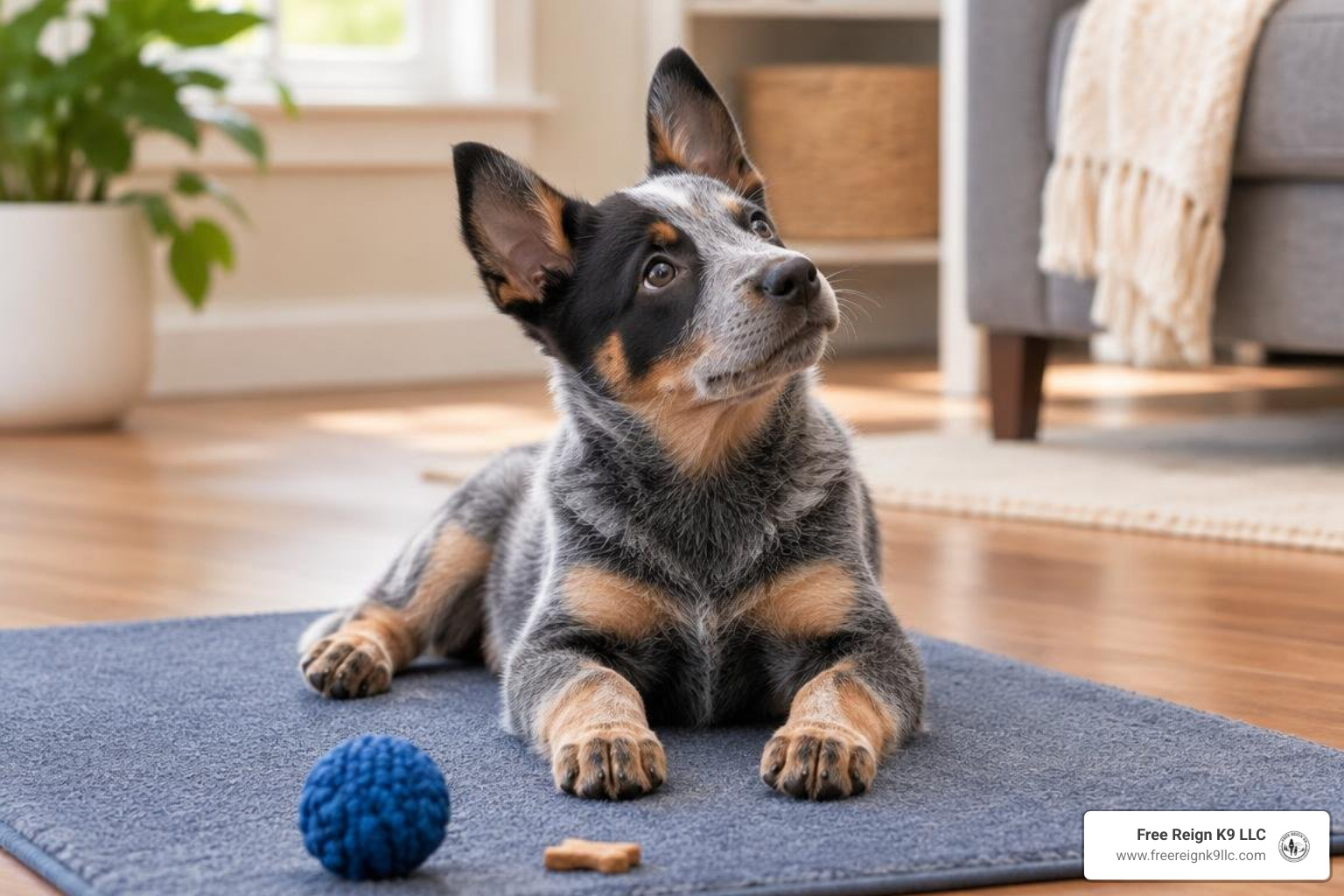
To train your Blue Heeler puppy, start with structured routines and positive outlets for their herding drive. Use marker-based training: say "Yes!" or use a clicker to identify the behavior you’re rewarding, then give the reward. Keep sessions short and focused rather than relying on long drills, and include mental challenges instead of trying to tire your puppy out through endless running. These foundations help you work with your puppy’s drive rather than against it.
Developed in the Australian Outback by crossing British herding dogs with the native Dingo, these dogs were built to withstand brutal conditions and drive stubborn livestock over vast distances.
This unique heritage means your pup comes hardwired with intense physical stamina, razor-sharp focus, and a high level of independent problem-solving. While a Golden Retriever might perform a command simply to please you, a Cattle Dog often runs a quick cost-benefit analysis first. They want to know that what you are asking makes logical sense and is worth their effort.
They are also famous for being "Velcro dogs." Your Heeler will likely bond deeply with you, shadowing your every step from the kitchen to the bathroom. Because of this intense devotion, they do not do well when isolated or left without purpose. If you do not provide structured guidance, their working drive will manifest in unwanted ways, like herding your vacuum cleaner or organizing your shoes into piles in the yard. Mastering essential skills for training cattle dogs means learning how to work with this natural drive rather than fighting against it.
Core Blue Heeler Puppy Training: Foundations, Schedules, and Commands
Consistency across your household helps your puppy learn what to expect. If one person allows them on the couch while another expects them to relax on the floor, the rules can become confusing. Focus on clear boundaries, a consistent reward marker such as "Yes!", and impulse control: helping your puppy pause and wait rather than immediately chasing or grabbing. Start building these habits when you bring your puppy home.
Starting Blue Heeler Puppy Training: The First 48 Hours and Housebreaking
The first two days in a new environment set the tone for your puppy's entire life. Your goal is to keep things low-stress while establishing a predictable routine.
- Create a Safe Den: Set up a crate in a quiet living area. Feed meals inside with the door open initially to help your puppy see it as a comfortable refuge rather than a punishment box.
- Follow a Regular Potty Routine: Offer a potty break roughly every 2 hours while your young puppy is awake, plus immediately after waking up, eating, or playing. Adjust the timing if they need more frequent breaks. Take them to the same outdoor potty spot on a leash, wait quietly, and reward immediately after they eliminate.
- Use Meals for Training: Use some of your puppy’s daily kibble allowance during training games. Hand-feeding gives you opportunities to reward gentle mouth habits, but do not assume it will prevent food-related resource guarding, which means defensive behavior when someone approaches their food.
If you want structured guidance right out of the gate, enrolling in Puppy Head Start Programs can help you establish these routines smoothly during the most formative weeks.
Essential Obedience Commands for Early Development
Keep your practice sessions short, about 5 to 10 minutes, two to three times a day. Always end on a successful repetition to keep your puppy eager for the next round.
- Name Recognition: Say your puppy's name in an upbeat tone. The second their head turns toward you, mark with a clear "Yes!" and deliver a treat.
- Sit and Down: Use a piece of kibble right at the nose to lure their head up and back for a Sit, or straight down between their paws for a Down.
- Bulletproof Recall: Call your pup using a cheerful, consistent cue. Never use your recall word to summon them for something unpleasant like a bath or nail trim.
- Leave It and Drop It: Teach impulse control by rewarding your pup for looking away from a closed hand holding food, graduating to releasing held toys on cue.
- The "Place" Command: Teach your dog to go to an elevated cot or mat and remain there until released. This builds a reliable indoor settle cue.
| Foundational Command | Primary Purpose | How to Introduce | Progression Goal |
|---|---|---|---|
| Name Game | Focus and engagement | Say name once $\rightarrow$ mark eye contact $\rightarrow$ reward | Instant focus in high-distraction outdoor settings |
| Sit / Down | Basic positioning & control | Lure smoothly with food at nose level | Verbal cue only with no hand luring |
| Place | Impulse control & calm settle | Lure onto mat $\rightarrow$ mark $\rightarrow$ reward on the mat | 30-minute duration stay while the household is active |
| Recall ("Come") | Safety & off-leash freedom | Call playfully $\rightarrow$ run backward $\rightarrow$ reward heavily | Immediate turnaround when called away from distractions |
| Leave It | Safety around dropped items | Cover treat $\rightarrow$ wait for disengagement $\rightarrow$ reward | Ignoring dropped food on the floor automatically |
Socialization Windows and Environmental Exposure
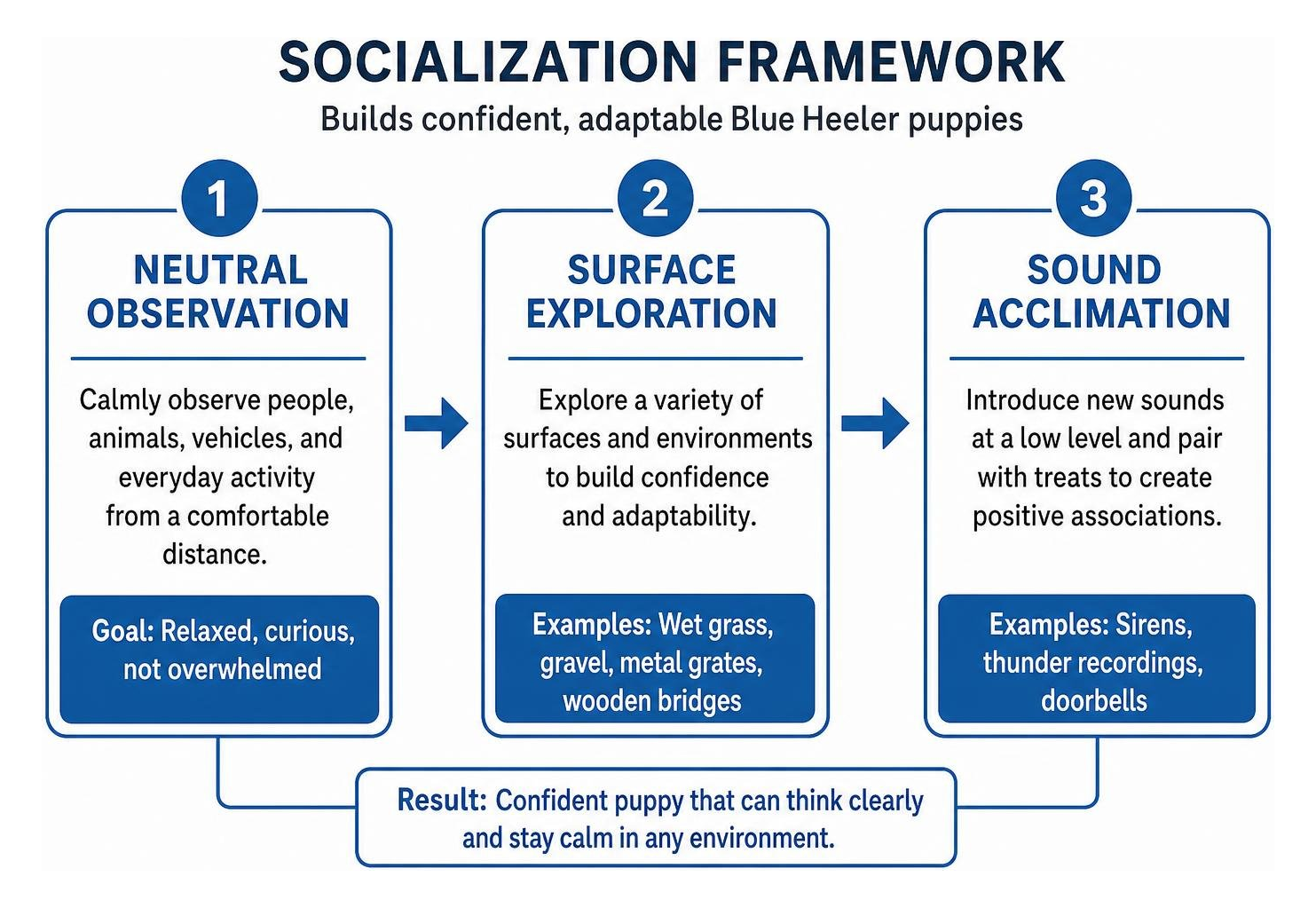
The main socialization window, when puppies are especially receptive to learning about new people, animals, and surroundings, closes around 16 weeks of age. Your Heeler may be wary of strangers, so make gentle, positive exposure part of your early routine.
Proper socialization does not mean letting every person and strange dog run up to pet your puppy. In fact, that approach often creates overexcitement or fear. Instead, focus on neutral observation.
Sit on a park bench in West Seattle or Tacoma and reward your puppy for calmly watching bicycles, strollers, skateboards, and joggers pass by. Expose them to different walking surfaces such as wet grass, gravel, metal grates, and wooden bridges. Pair novel sounds like sirens, thunder recordings, and doorbells with tasty treats. This builds a rock-solid, confident dog that can think clearly in any environment.
Managing Herding Instincts, Nipping, and High Energy
Managing Nipping and Redirecting the Urge to Chase
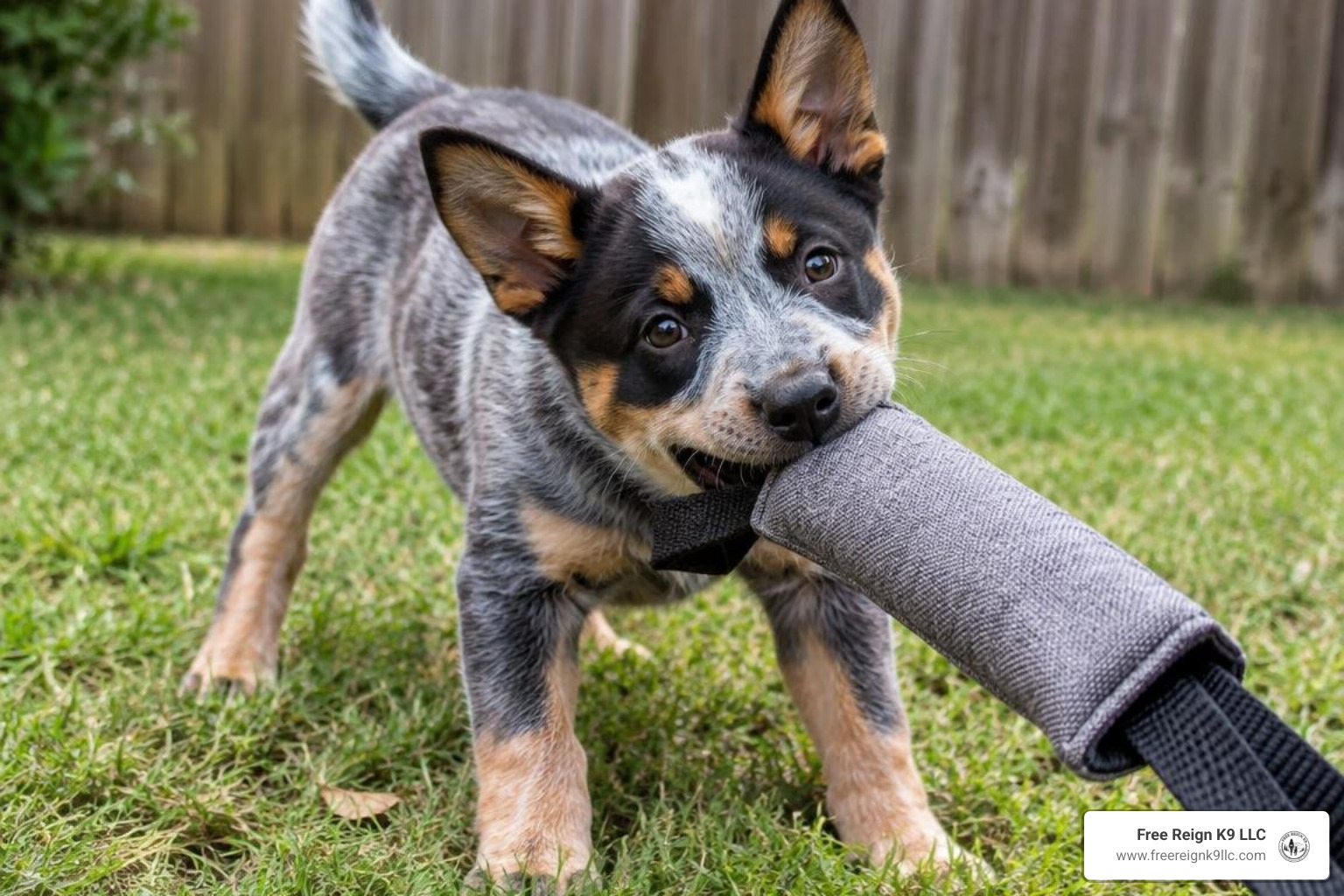
Heelers earn their name from their instinct to nip at the heels of cattle to move them. In your home, this hardwired drive makes fast-moving ankles, pant legs, and running children prime targets. It is crucial to understand that this is not malice or aggression; it is pure working instinct.
Teething begins early, but discomfort typically peaks between 12 and 16 weeks of age. All adult teeth should arrive by roughly six months. During this teething window, biting behavior can feel relentless.
To manage this, follow structured bite inhibition techniques for cattle dog puppies:
- The Freeze Method: When your pup grabs your pant leg or ankle, stop moving. Moving feet can encourage your puppy to chase and nip, so stay still and keep your response calm.
- The Toy Swap: Keep an appropriate toy handy, such as a braided fleece tug or rubber toy. When your puppy approaches looking ready to nip, offer the toy before they make contact with your skin.
- Calm Breaks: If your puppy becomes overexcited and keeps biting despite redirection, calmly guide them to their playpen or crate for a 5-minute quiet break. Give them a chance to settle rather than expecting them to nap on cue. Consider whether they need rest or a quieter environment.
Advanced Blue Heeler Puppy Training for Impulse Control and Leash Walking
Because Heelers are powerhouse athletes with intense drive, leash manners must be taught early. Letting a 15-pound puppy pull you down the sidewalk guarantees you will struggle with a 45-pound adult dog later.
Use a standard flat collar for leash practice. Free Reign K9 recommends a standard 6-foot, 1/2-inch braided leash made from quality leather as its best overall leash. Practice the stop-and-wait method: the moment tension hits the leash, freeze in place. Do not yank back. Wait for your puppy to release the tension and look back at you, mark the focus with "Yes!", reward at your hip, and step forward again.
Practice waiting at doors and other exits, too. Teach your puppy to sit and wait before you open the backyard door, let them out of the crate, or help them out of your vehicle. If persistent pulling is making walks frustrating, structured Dog Private Individual Training Lessons offer personalized, one-on-one coaching to help you practice clear cues, reward timing, and leash handling.
Mental Stimulation and Structured Exercise Routines
It’s tempting to try to wear out your Blue Heeler through endless running, but more exercise is not always the answer. Forced, repetitive running on pavement can put developing bones and joints at risk, including growth plates, the areas of developing tissue near the ends of a puppy’s bones. Avoid making longer and harder runs your main strategy for managing energy.
Give your puppy a mental challenge as well as opportunities to move. Try a 15-minute nosework game, where they search for food or another scent, or a short obedience session rather than relying on a 45-minute sprint to tire them out. These activities are not minute-for-minute equivalents, so adjust the session to your puppy’s attention and energy.
- Scent Games: Hide your puppy's kibble under cups, inside cardboard boxes, or scattered across your lawn for them to hunt down.
- Flirt Poles: Use a lure on a rope to practice rapid impulse control. Ask for a "Sit," release them to chase the lure for a few seconds, then cue "Drop it" and reset.
- Treibball and Ball Work: Channel herding instincts by teaching your pup to push large exercise balls across the yard using their nose.
- Object Discrimination: Teach your puppy the specific names of their toys so they can search and retrieve them on command.
Frequently Asked Questions About Raising a Heeler
How do you stop a Blue Heeler puppy from nipping at running children?
Running children can trigger your cattle dog’s urge to chase and herd. Teach children to "become a tree": stand still, cross their arms, and look at the sky when the puppy approaches excitedly. An adult should always supervise interactions between puppies and young children rather than relying on children to manage nipping. During supervised time together, use a light indoor leash to prevent chases before they start, and redirect your puppy’s urge to chase into fetch or structured tug games. Remove the leash when supervision ends.
How much daily exercise does a cattle dog puppy need?
Puppies do not need long, grueling hikes. Instead, aim for multiple short exercise bursts of 15 to 20 minutes of playtime in a fenced yard, paired with 30 to 45 minutes of total mental enrichment spread throughout the day. Save the long trail runs on Pacific Northwest terrain until your veterinarian confirms their growth plates have closed, usually around 12 to 14 months of age.
When is it time to seek professional training support?
While standard puppy mouthing is normal, you should reach out for help if your puppy shows genuine resource guarding over food or items, displays fearful snapping toward strangers, or if everyday biting regularly breaks skin despite consistent redirection. In these cases, getting dedicated dog behavior modification training ensures you address the root cause safely before unwanted patterns become permanent adult habits.
Raising a Resilient Working Partner
Raising an Australian Cattle Dog is one of the most rewarding adventures in dog ownership. While the puppy stages will test your patience, their loyalty, work ethic, and intelligence are unmatched when guided with consistency and purpose.
At Free Reign K9 LLC, our balanced training philosophy is built around creating clear communication, solid boundaries, and reliable real-world manners, with education on safe, proper training-tool use tailored to each dog and situation so you can enjoy true freedom with your dog outdoors. Depending on the dog and situation, our trainers use tools such as prong collars and electronic training collars (e-collars) to teach through feedback. Whether you need help setting up early puppy routines or tackling stubborn behavioral quirks across Seattle, Tacoma, and surrounding communities, explore our comprehensive training programs or take the first step and schedule your evaluation with our team today.